|
 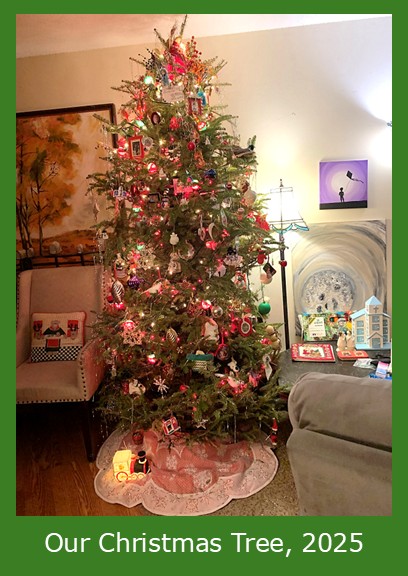 The Christmas Tree and Christianity The Christmas tree tradition holds deep significance for Christians and offers a powerful way to symbolize Faith during the Christmas Season. Central to this tradition lies the evergreen tree, which retains its green foliage even in the depths of Winter and thus serves as an emotional reminder of the Eternal Life offered through Faith in Jesus Christ. The lights adorning the Christmas tree further enhance its symbolism. These lights represent Jesus as the ‘Light of the World.’ They serve as a reminder that through Jesus, the world receives the Light of Salvation, dispelling darkness and offering the path to Spiritual Illumination. The act of decorating the tree with ornaments, often including stars at the tree's pinnacle, aligns with the Christian message of Jesus as the Guiding Star leading the way to salvation, as was the case for the Magi who followed the Star of Bethlehem to find the newborn Messiah. The act of coming together as a family or community to decorate the Christmas tree fosters a sense of unity and joy as the Birth of Jesus brought to Humanity. Christians can use the Christmas tree as a centerpiece for reflection and prayer, focusing on the profound spiritual message it conveys. It serves as a tangible reminder of the central message of Christianity: the gift of Eternal Life and the Hope, Light, and Joy that Jesus brings to the world. In this way, the Christmas tree becomes not only a beautiful tradition but also a meaningful expression of Faith, drawing believers closer to the heart of their Christian beliefs during the Christmas Season. The Christmas tree is a wonderful and historic tradition that we decorate our homes with every Christmas to fill us with Spirit and to lay our gifts underneath. However, it is the Birth of our Lord and Savior, Jesus Christ, on the very first Christmas that we celebrate. 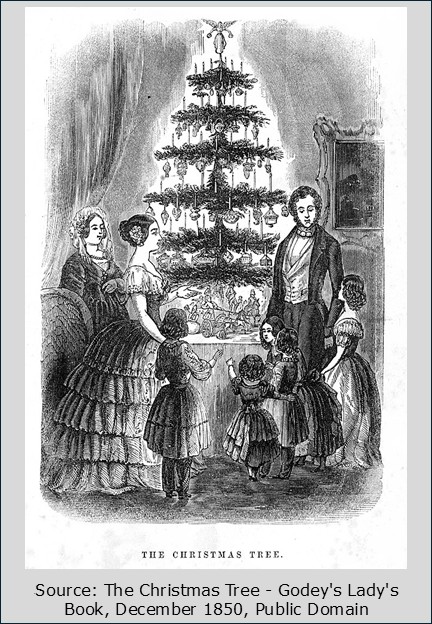 Roots and Symbolism of Christmas Trees There are several origins of usage of an evergreen tree for symbolic meaning. Before Christianity, people paid special attention to green plants and trees in the winter. While modern people decorate their homes with pine, spruce, and fir trees during the holiday season, people in the ancient world hung evergreen boughs over doors and windows. Evergreen trees were believed to keep witches, ghosts, and evil spirits away in many countries. The longest day and shortest night of the year fall on December 21 or December 22 in the Northern Hemisphere. People used to believe that the sun was a god and that winter came every year because he became ill and lost his strength. In ancient times, the Solstice meant that the sun god would finally get well. They thought the evergreen boughs reminded him of all the green plants that would grow again when the sun god was strong, and summer came back. The ancient Egyptians worshiped a god named Ra, who had the head of a hawk and wore the sun as a blazing disk on his head. When Ra was recovering from his illness, at the Solstice, the Egyptians threw palm rushes in their homes, symbolizing life's triumph over death. The early Romans celebrated Saturnalia, a festival of the solstice that celebrated the agricultural god Saturn. Farms and orchards were going to be green and fruitful as soon as the solstice hit. The Buddhists celebrated by decorating their temples and homes with evergreen boughs. As a symbol of Eternal Life, the ancient Celt priests, known as the Druids from the now present-day United Kingdom, decorated their temples with evergreen boughs. As far as the Vikings were concerned, evergreens were a special gift from Balder, the sun god. But the real origin of today's Christian tree traditions can be traced back to Germany. The German Origin of the Christmas Tree The tradition of decorating Christmas trees has a rich history that is closely tied to Christian traditions, particularly in Germany during the 16th century. This practice played a significant role in shaping the Christmas tree tradition we know today. In Germany, devout Christians began the tradition of decorating trees in their homes as part of their Christmas celebrations. The use of evergreen trees held symbolic meaning, representing the Eternal Life offered through faith in Jesus Christ. These early Christmas trees were adorned with decorations and sometimes even edible items like fruits and nuts. As time went on, the popularity of Christmas trees grew, but there was a challenge. Wood, typically used for the trees, became increasingly scarce. In response to this scarcity, some people began constructing Christmas pyramids made of wood. These pyramids were decorated with evergreen branches and candles, creating a festive and visually striking display. One of the legendary stories associated with the addition of candles to Christmas trees involves Martin Luther, the Protestant Reformer. According to the legend, as Luther was walking home one Winter night, he was struck by the beauty of the starry sky through the evergreen trees. Inspired by this scene, he decided to recreate it for his family. He erected a tree in their main room and decorated it with lighted candles, symbolizing the stars. This act is said to be one of the earliest instances of candles being used on a Christmas tree, and it contributed to the tradition's evolution. From an article by Glory Dy—Christianity.com Contributing Writer. Published Dec 09, 2025 For the full, very interesting and informative article, please go to: https://www.christianity.com/wiki/holidays/what-is-the-origin-of-the-christmas-tree.html 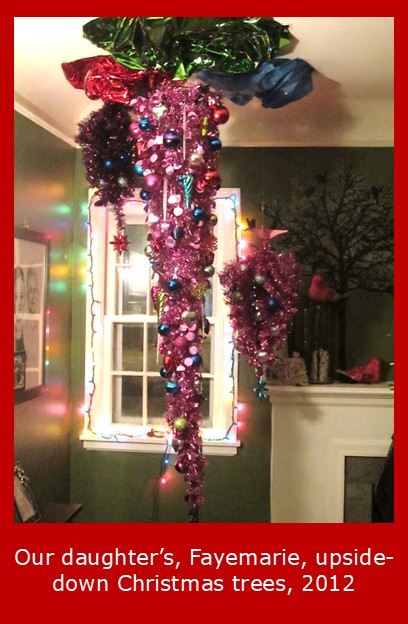
Spiritual Symbolism of the Upside-Down Christmas Tree The upside-down Christmas tree embodies several layers of Spiritual Meaning: By turning the tree upside down, the ordinary is transformed into a symbol of the extraordinary. This reversal mirrors spiritual teachings where humility and surrender lead to enlightenment and connection with the Divine. It serves as a physical representation of “turning the world upside down” to reflect spiritual truths. The triangular shape formed by the inverted tree points heavenward, symbolizing the Father, Son, and Holy Spirit. It invites contemplation on the mystery of the Trinity, a central doctrine of Christianity celebrated during Christmas. Historically, some believed the upside-down tree offered protection from evil spirits. The unusual shape was thought to confuse malevolent forces, safeguarding the household during the holy season. Spiritually, the upside-down tree challenges traditional views and invites believers to see Christmas in a new light. It encourages introspection on what truly matters during the season: love, grace, and the birth of Christ. Contemporary Christmas devotionals occasionally refer to the upside-down tree as a metaphor for Spiritual Renewal. The unusual tree inspires believers to reexamine their Faith and Christmas practices, encouraging deeper devotion beyond commercial festivities. Many Devotionals emphasize how flipping familiar traditions can lead to fresh Spiritual Insights, much like the symbolic upside-down tree itself. During holiday sermons and meditations, the tree’s shape often serves as a visual aid to explore themes of sacrifice, hope, and the transformative power of Christ’s birth. It is a reminder that Christmas is not just a festive occasion but a call to align one’s life with divine purposes. Free Daily Devotional. Hyacinth 03/06/2025 For the full article, ‘Why The Upside Down Christmas Tree? Spiritual Meaning & History,’ please go to: https://www.freedailydevotional.com/archives/10775#google_vignette It is also said that having the Christmas tree upside down illustrates the wide Blessings of God focusing down to one point, Earth.  Newsletters Update. All our Newsletters are now archived at the Blog section of our website. Read these interesting and informative Newsletters. http://jabirubooksbelize.com If you know someone who would like to receive our monthly Newsletter, please have them go to CONTACT on our website and send us an e-mail. Please note that our monthly Newsletters are also published on our FaceBook page at: https://www.facebook.com/JabiruBooksBelize Thank you for forwarding and sharing this Newsletter. BOOKS WRITTEN BY DR. HENRY W. ANDERSON Add these great books to your personal library for your reading pleasure; available as e-books and printed books.  INFORMATION/LINKS Dr. Anderson books are available both as Print-on-Demand and E-Books at store.bookbaby.com (Recommended by Publishers). Please go to: https://store.bookbaby.com/profile/jabirubooksbelizecom Dr. Henry W. Anderson’s books are available at the libraries of the Belize National Library Service and Information System. Search under Author: Henry W Anderson. Please go to: https://bnlsis.mlasolutions.com/m5/catalog/(S(tsaodaxofc2mvp3zhpl4wwt2))/Default.aspx?internal=1&installation=LeoBradley E-Books are available at other Retailers: Amazon, Barnes & Noble, Apple Books, Vearsa, Kobo, OverDrive, Copia, Gardners Books, Baker & Taylor, eSentral, Scribd, Ciando, Hoopla, Playster, and many more. Print-on-Demand books are available at some of the Retailers listed. Please visit us at: https://www.facebook.com/JabiruBooksBelize Visit our website at http://jabirubooksbelize.com 
|