|
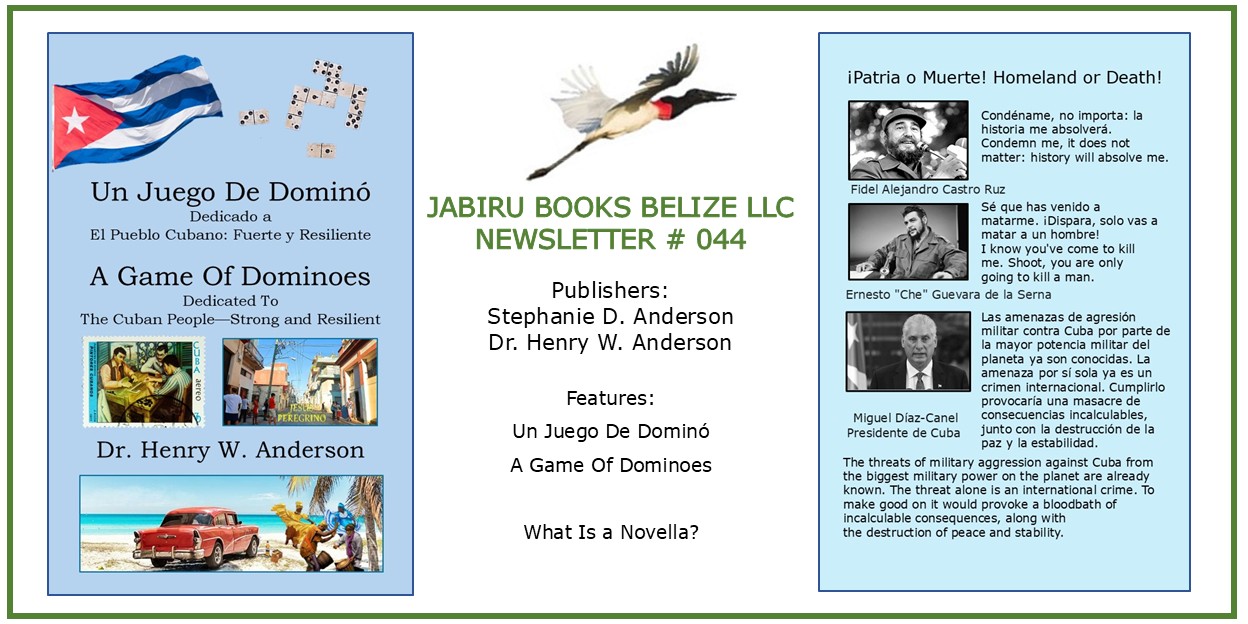 Publishers’ note: We apologize for the late publishing of our April Newsletter. A Game Of Dominoes Un Juego De Dominó Jabiru Books Belize is proud to announce that Dr. Anderson’s latest work, A Game of Dominoes, will soon be available as both an E-book and Print-on-Demand. It will be published in Spanish and English, both versions in each book. Like all of Dr. Anderson’s works, it is well researched. A Game of Dominoes is a novella. It is set in Centro Habana, Cuba, on Calle Jesús Peregrino. The street was named Jesús Peregrino, a clear Christian allusion, from the beginning of the 19th century because of an altarpiece with that image that a freed black carpenter, like Jesus of Nazareth, who lived on the street, had in his house. The name Jesús Peregrino (Pilgrim Jesus) is associated with the representation of Jesus of Nazareth on his pilgrimage. Four friends have gathered to play dominoes, as they often did, on the side of the street. It is Holy Saturday: Anto–Antonio Miguel Perez Hernandez is sixty-seven years old, a musician and a taxi driver. He has a Bachelor’s Degree, is retired from the Ministry of the Revolutionary Armed Forces, and is a veteran of the FAR (Revolutionary Armed Forces of the Republic of Cuba). Zumo (Juice)–Juan Carlos Gonzalez Sanchez is twenty-four. He has completed his Obligatory Military Service (SMO) and is a doctor at Freyre de Andrade Surgical Hospital. Món–Ramón Luis Martinez Lopez is also 24. He is a soldier and has just been promoted to Sub-Lieutenant–One Star–in FAR (Revolutionary Armed Forces of Cuba). Robo–Roberto Fernando Garcia Diaz is twenty and has completed his Obligatory Military Service (SMO). He is a bartender at El Gato Tuerto (The One-Eyed Cat). The novella is not only about dominoes, but the four friends discuss many topics relevant to Cuba of today. These conversations are guided by Anto, the eldest and most knowledgeable. Topics include the United States embargo and sanctions, and the failure of the world to have them stopped; the Cuban Revolution and the role the United States played in bringing it about; the current threat of aggression by the United States; personalities like Fidel Castro, Che Guevara, Marco Rubio; even baseball, basketball, the various uses for condoms in Cuba, among many others; and there is a lot of humour. Below are the first six paragraphs of A Game Of Dominoes A Game Of Dominoes Anto (Antonio Miguel Perez Hernandez) sat at the makeshift wooden table on the streetside of Jesús Peregrino Street looking at the three rickety chairs facing him, holding his Tres Guitar. It was mid-afternoon and he was dressed for the weather wearing a faded pink undershirt, faded blue jeans, green flipflops, cream straw-hat with a black band, and dark glasses. He was just under six feet, dark skinned, slim, had a narrow chin and sharp nose; he wore a thick greying moustache. It was a pleasant day in Centro Habana, typical for April, good for outdoor activities, the temperature in the upper seventies, but it felt a bit warmer due to the humidity. The skies were blue, scarcely a cloud in the bright sun-filled sky, no impending showers seen, a slight breeze making in down Jesús Peregrino Street. He drew in deeply on his Cohiba cigar, enjoying the aromatic smell and taste. He sighed. I had better put this away or Doctor Zuma will enjoy scolding me. He reflected on the story of the cigar and smiled. Everything in Cuba had its history. One of Fidel’s bodyguards shared some of his private supply of cigars made by a local artisan named Eduardo Rivera. These cigars pleased Fidel so much that a special production of the unbranded blend, produced under tight security, was made for Fidel and other top government officials. Now Cohiba was known all over the world. Anto (Antonio) stubbed out the lighted cigar and dropped in in his cloth bag which was on the street beside him. “Late, as usual,” Anto (Antonio) grumbled, beginning to strum his Tres Guitar. “Young people!” He stared around him at the buildings that lined Jesús Peregrino Street, at the once beautiful ornate facades of the Spanish colonial architecture, the vibrant pink, blue, beige, yellow colours now faded; yet an occasional building stood brightly painted. He glanced at his machine (car), a 1950 red Crysler convertible, and wondered how much longer the engine, now made up of many Russian parts, was going to hold up. It needs to keep going. I need that extra taxi money. He shook his head. And the shortage of gasoline, thanks to the U.S.’s embargo, that‘s not helping. He kept shuffling the fifty-five dominoes, the tiles worn smooth by use, picked up one and slammed it down on the table. “Fuck!” he cussed. “Never on time!” The street was not very busy. It was Holy Saturday and many people had gone to the beach or the parks. He wondered, momentarily, if he should be out there with his taxi making some money. He shook his head again. He had never worked on Holy Saturday, and he was not going to break that tradition. A popular park was ‘Parque de la Fraternidad (Fraternity Park).’ It had a lot of green open spaces and recreational areas and was also one of the best connected as it was close to several bus lines and taxi services. In the very centre of ‘Parque de la Fraternidad’ was a large ceiba tree called the Árbol de la Fraternidad Americana (Tree of American Brotherhood). Anto grimaced. No ‘brotherhood’ as far as the U.S. was concerned. There was ‘Parque de la Ciudadela’ (Citadel Park) which was good for families as it had playgrounds and sports facilities for children. It was an enjoyable place to go as it was near to the coast, easily accessible from the Malecón—Havana's famous seawall—and adjacent to the historic Castillo del Morro, had beautiful gardens and views of the harbor. He felt sad, momentarily. He had no children. He waved the thought aside and he smiled as he remembered ‘Parque de Los Enamorados’ (Lovers’ Park) and how he used to go there to meet with the girls. It was a very romantic park with beautiful landscaping, ideal for couples especially in the late evening, and he had visited it often. He sighed. He was no longer in that group. There were parks he would never go to, however, like ‘Parque John Lennon.’ There was no way he was going to sit at a peaceful spot and look up at John Lennon’s statue, hoping for relaxation, seeing if his glasses had been stolen once again. He was too young for that. He liked going to ‘Parque Don Quixote’ as there were places nearby like the Coppelia Ice Cream Parlor, the Yara, Rampa, and Riviera Cinemas. He loved El Cochinito Restaurante although he could not afford to go there often, only on special occasions like his wife’s, Valeria, birthday. It had a large room on the terrace adorned with colourful paintings and a view of the beautiful patio where a giant tree was planted that refreshed and shaded the place from the intense sun and heat of the day. There was also a platform where live performances of musical groups were performed. What he also liked was that it was easy to get there by several bus routes, and he did not have to use his 1950 red Crysler convertible. Save on gasoline. He often took tourists from the Habana Libre, Colina, Nacional de Cuba, and Vedado hotels to the restaurant, so he was well known there and would always get a discount when he visited. He also took tourists to other nearby places of interest like the Napoleonic Museum, and the Cuba Pavilion which was a popular fairground and venue for important exhibitions of works of art, recreational activities, fairs and events. Sometimes, he and the boys—Zumo, Món, and Robo—loaded up the car and went to play dominoes under a Royal Poinciana tree in one of the parks, the tree beautiful for its fern-like leaves and flamboyant display of orange-red flowers, feeling the sweet and soft easterly winds on their faces. He couldn’t do that anymore because of the shortage of gasoline due to the U.S. embargo—couldn’t do a simple thing like that. What is a Novela? The Difference Between Short Stories, Novelettes, Novellas, and Novels Flash Fiction: 53 – 1,000 words Short Stories: 3,500 – 7,500 Novelettes: 7,500 – 17,000 Novellas: 17,000 – 40,000 Novels: 40,000 + words Flash fiction, also known as short, short stories, micro fiction, or postcard fiction, are stories that take pride in their extreme brevity: some works of flash fiction have only 53 words, while others have 1,000. A short story is one of the most common forms of writing. It is often used to describe a single event, a single episode, or a tale of one particular character. A short story does not usually involve major twists and conflicts, and the involvement of various sub-plots and multiple characters is not common. A short story is basically fictional prose, written in a narrative style. However, the narrative style may either be first person or third, or whichever the author chooses. A novelette is also narrative fictional prose. In the past, the term ‘novelette’ referred to a story that was romantic or sentimental in character. In modern times, the term is rarely used, and novelettes are rarely published singly. A novella is longer than a novelette and is sometimes called a long short story or a short novel. Although in the past, novellas were commonly written and published, and some to great acclaim—A Clockwork Orange by Anthony Burgess and The Metamorphosis by Kalka—these days it may be more difficult to get a novella published; they are often published as standalone works or in collections. Novellas are more often focused on one character’s personal and emotional development rather than on large-scale issues; they tend to have a quicker pace, delivering a concise narrative. The novella is often written with a satirical, moral, or educational purpose in mind. They are ideal for readers seeking a shorter, impactful story. The novel is one of the more common works of fiction that we encounter. A novel often involves multiple major characters, sub-plots, conflicts, points of view, and twists. The plot moves forward through many characters, actions, thoughts, time periods, and situations. The reader often feels that the story deviates and is affected by the involvement of different sub-stories and sub-plots, by the passage of time, or by the involvement of new important characters.  Newsletters Update. All our Newsletters are now archived at the Blog section of our website. Read these interesting and informative Newsletters. http://jabirubooksbelize.com If you know someone who would like to receive our monthly Newsletter, please have them go to CONTACT on our website and send us an e-mail. Please note that our monthly Newsletters are also published on our FaceBook page at: https://www.facebook.com/JabiruBooksBelize Thank you for forwarding and sharing this Newsletter. BOOKS WRITTEN BY DR. HENRY W. ANDERSON Add these great books to your personal library for your reading pleasure. They are available as e-books and printed books. 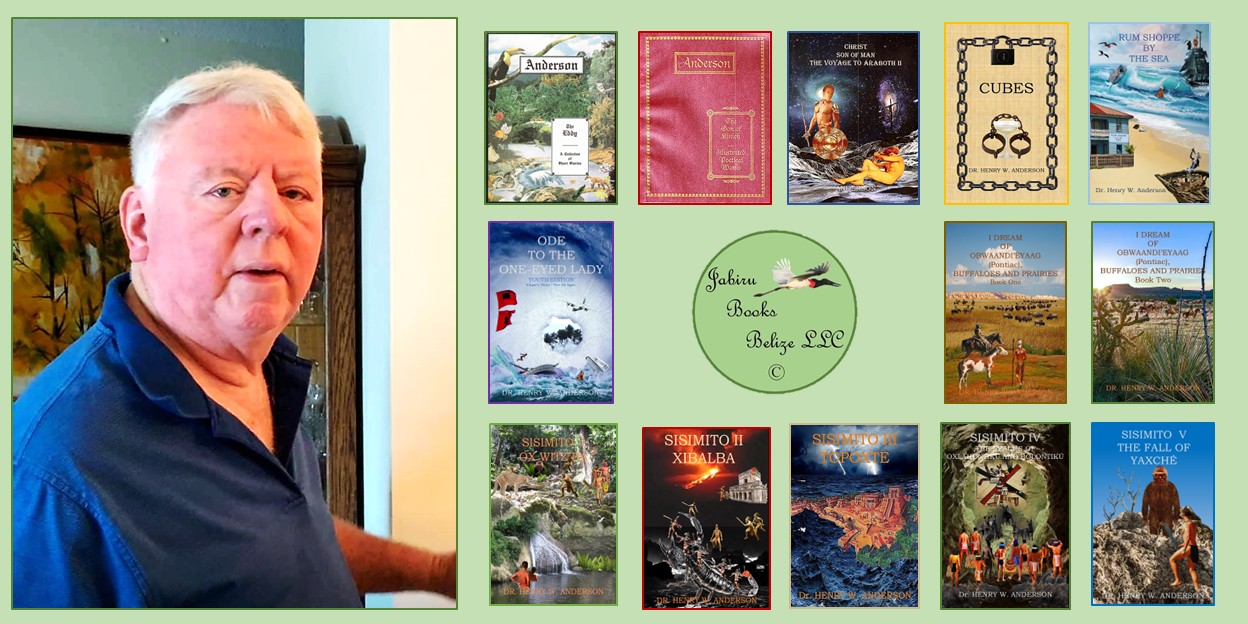 INFORMATION/LINKS Dr. Anderson books are available both as Print-on-Demand and E-Books at store.bookbaby.com (Recommended by Publishers). Please go to: https://store.bookbaby.com/profile/jabirubooksbelizecom Dr. Anderson’s books are available at the libraries of the Belize National Library Service and Information System. Search under Author: Henry W Anderson. Please go to: https://bnlsis.mlasolutions.com/m5/catalog/(S(tsaodaxofc2mvp3zhpl4wwt2))/Default.aspx?internal=1&installation=LeoBradley E-Books are available at other Retailers: Amazon, Barnes & Noble, Apple Books, Vearsa, Kobo, OverDrive, Copia, Gardners Books, Baker & Taylor, eSentral, Scribd, Ciando, Hoopla, Playster, and many more. Print-on-Demand books are available at some of the Retailers listed. Please visit us at: https://www.facebook.com/JabiruBooksBelize Visit our website at http://jabirubooksbelize.com 
|