|
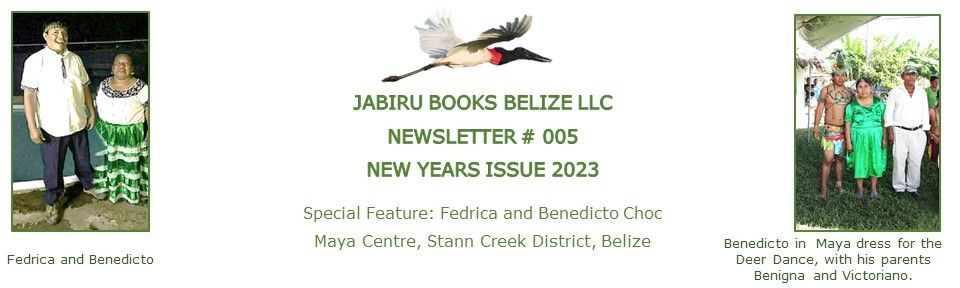
From Benedicto Choc:
I, Benedicto Choc (Ben, aka Bensimito), was born in the Pueblo Viejo Village located in the beautiful rolling hills of Toledo District, the most southwestern part of Belize, seven miles from the Guatemalan border. I am the son of Victoriano Choc who is the son of Gregorio Choc, and Benigna Salam-Choc the daughter of Thomas Salam. I am the fifth on nine children.
My village is surrounded by mountains that is excellent for hiking, camping and for exploring caves. Flowing through the community is a pristine fresh stream used by villagers for bathing and washing. Further down the stream are two great water falls, 30ft and 75ft in height, with refreshing pools. Other than the residencies, there is a Catholic church, a school, a football field, and one dirt road.
Pueblo Viejo was the first village to be formed in Southern Belize and when Miguel Coc, born 1911, visited the village, it was deserted and had only one house post standing. The village was resettled and I still recall the few pioneering Maya families of the community: Rafael Villanueva, Thomas Salam, Gregorio Coc, Eusebio Choc, Secundino Coc Sr, Ramon Coc, and Apolonio Sho, all deceased except for Mr. Thomas.
Living in a Maya community is very unique. We work as a team, the men helping each other through bartering, building houses, assisting each other in cultivating our farms. Subsistence farming is essential and I remember the many times my father, my older brother and sisters, and I had to make the grueling six miles walk on rugged terrain, carrying our produce of corn, beans, and rice on our backs all the way to Santa Cruz, Guatemala, to sell. The women, at times, would come together to prepare the traditional food ‘Caldo’ along with fresh corn tortillas and ground chili peppers. Later, however, and during Ceremonies, our wooden instruments–the harp, marimba, flute, and drum–provided musical entertainment for us
During special occasions or village fairs, we would dance the intense Deer Dance which would normally take five to six hours in which to complete the 24 songs, the dance lasting for three to four days. Different musicians would play the harp, marimba, drums, and the flute, instruments that are very important for entertainment throughout night. Everyone enjoyed themselves, young and old, dancing as if though there was no tomorrow. Growing up with our traditional food and music has helped me to appreciate my community as we lived in peace and harmony. There was no crime, no politics, and everyone had respect for each other.
Village life was not what it is today and parents had to ensure that their children were prepared to live on their own: young men had to learn how to farm and young women to cook. Learning the traditional practices, skills, and knowledge were essential for success in those days: skills in subsistence farming–how to plant, when to plant, the selection of seedlings for planting–hunting, how to build a thatched house, how to obtain food from the forest, how to identify plants that were edible and nonedible, how to recognize different sticks and vines for wooden construction and those used in arts and crafts.
It was not all hard work for my father taught me to play the harp and violin, all by listening, and I was eventually allowed to play a few songs on his harp. I enjoy music and love to dance as well, so I learned to dance to the very graceful harp music, the smooth and moderate marimba, and the rough flute and drum. My father finally allowed him to take part in the Deer Dance and I actually learned to dance the role of each performer.
School was not an early option for me and I did not start until I was seven, schooling not being mandatory in the Maya culture. Initially, I had doubts about school as I enjoyed being with my father on the farm. I managed to stay in Primary School and, despite being absent quite often, was able to pass my tests. I graduated and passed the exam for High School admittance. I was very happy about that for it was the cultural practice to arrange marriages for teenagers so it was either school or marriage and I wasn’t ready for the latter endeavour at age sixteen. I always wanted to learn more.
Going to High School would present difficulties, however. I attended Toledo Community College and road conditions were very bad. I had to travel for two to three hours. I would leave home for school about five o’clock in the morning and did not get back home until six or seven o’clock in the evening. There was no electricity so I had to struggle to read with our homemade kerosene lanterns, not recommendable for reading, but I had no choice. Of course, there were also financial concerns because there were no subsidies for education. Parents had to keep up with all bills at school. I knew I had to press on with my schooling, but I saw the burden it placed on my parents and, of course, the entire family felt it too. I decided to find a weekend job. I love planting, chopping, so did those and later on I became my uncle's helper in construction and I was able to learn these skills in addition to those at school. I made $5.00 a day, $10.00 when I worked the weekend.
I graduated pretty late from High School, at age 19, because I had not started at a young age. Five years after, age 24, I married a beautiful and highly culturally oriented lady, Fedrica Saqui, of Maya Centre. She was a graduate of Stann Creek Ecumenical College and also attended Junior College. Fedrica and I then attended the Toledo Community College’s ‘Hospitality Management Course.’ After that, I did my Tour Guide course and recently completed my Professional Course in Tourism.
Together, Fedrica and I, continue to work through a lot of obstacles and challenges as we try to achieve our goal: “The preservation and safe guarding of our unique culture and traditions for future generations to enjoy–our language, food, music, arts, beliefs, and traditional farming system. To this purpose, we are always grateful to share this traditional knowledge which was passed on to us by our parents and I must state that I would never have been able to accomplish all I have without the help of my parents.
Today, when I look back at the way I have lived, it makes me very sad to see that our traditional practices and culture are now declining. Our younger generation has lost interest in the traditional practices because of modernization, jobs, and social partners. The Mopan Maya youths of today no longer want to wear their traditional dress, no longer want to speak their Mopan Maya language, no longer want to do farming, no longer want to cook, no longer want to learn how to play the traditional Maya instruments, and no longer want to learn traditional healing and the use of medicinal plants. They believe our way is the poorest way to live while I believe the opposite. It is a rich way to live. We must keep our ancestral knowledge alive or it will be lost forever.
From Fedrica Saqui-Choc:
Maya Center Village, established on January 2 1976 in the Stann Creek District, Belize, is the place that I will always call home, having been born there, having grown up there, a paradise of hope and future. My parents, my dad, the late Pedro Saqui, and my mom, Elogio Sho, along with other villagers left San Antonio, Toledo District, seeking a better life for their children. They first settled in Maya Mopan Village for a year before they decided to seek another place. Maya Mopan was far from the main road, now the Southern Highway, and it was difficult to transport their produce for sale in Dangriga.
They walked from Maya Mopan, heading north, until they found a place along the southern highway with a running stream and fertile land, good for subsistence farming. They immediately started to clear the area to construct their temporary homes, getting the materials from the surrounding forest. After several trips, to and from, the houses were completed. As I said before, the area was a paradise. There was abundant fish, game meat, and wild birds, and they only had to walk a few miles to conduct the milpa system. Life was enjoyable.
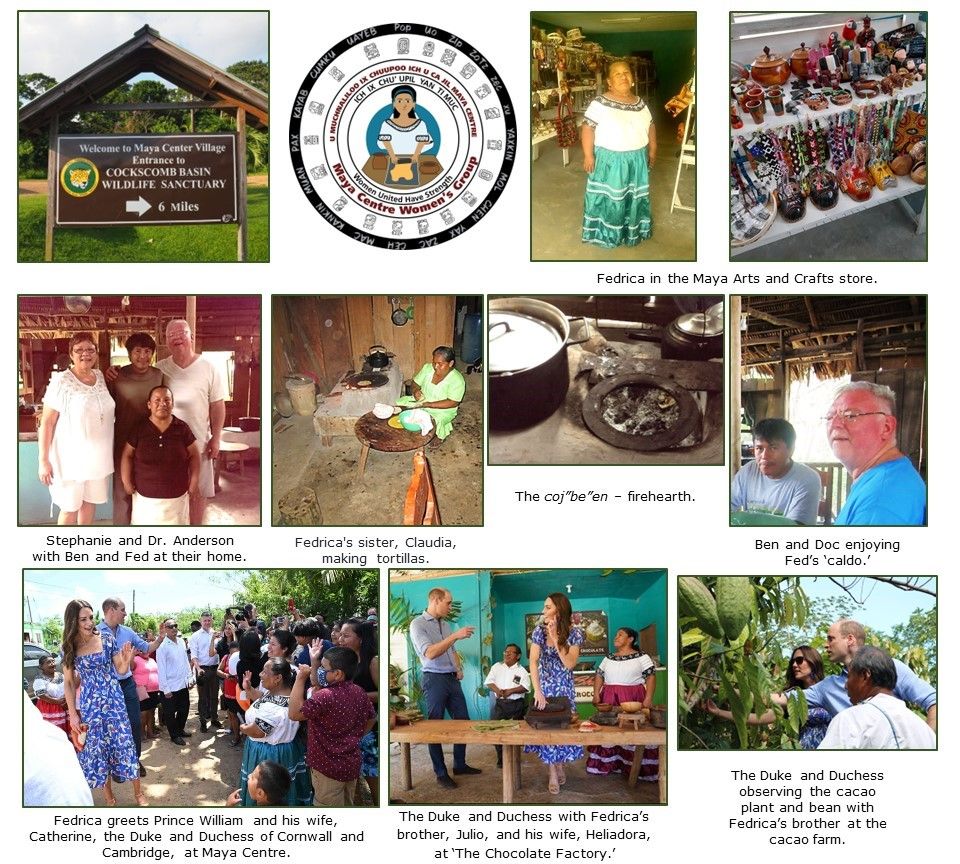
But life changes. In 1984, the Cockscomb Basin was declared as a Protected Area. There was to be no more fishing, hunting, logging, and burning. The Maya villagers in the area had nowhere to go. Fortunately, the Cockscomb Basin Wildlife Sanctuary (CWBS) was established and brought tourism to our doorsteps. Initially, it was a battle for our people to undertake Tourism, but when we saw the potential benefits, we gradually accepted it and launched into Conservation. In 1987, the Maya Center Women’s Group was established and I later join in 1999. In 2000, I became the Chairlady and served for four years. Under my leadership, I lobbied for grants from different agencies to construct a bigger building for the Maya Center Women’s Group and, fortunately, the European Union granted the group BZ$40,000.00 to construct the current building. In 2004, I vacated the post.
Years after, I married Benedicto Choc, an extreme adventurer and culturally oriented person like myself. Along with my interest and participation in the Women’s Group, my interest in culture became stronger and I wanted to showcase who we are as Maya, not only through art, music and dance, but through our food as well; I have always had a passion for cooking. So, together, Ben and I ventured into Traditional Cooking sessions making mainly our traditional chicken soup dish called “Caldo,” as well as many additional delicious organic dishes.
During a session, we walk the guests through the entire process: chasing and catching their chicken then cooking it. They also test their muscles on the grinding stone, grinding their corn, turning into a paste (masa), then making and baking their own tortillas. After all that, they would enjoy their freshly cooked meal. Once that is done, we dance to the tune of the harp and marimba, our traditional music. Our goal in not only to share our food with our guests, but it assists us in safeguarding this knowledge which can lessen as years go by. Together, Ben and I, we continue our mission to get many to understand and appreciate that the Maya have a unique way of living and nurturing their being, and this allows us to survive.
From Ben: Mr Victoriano Choc:
My father is an avid harp player of our cultural music, having learned how to play when he was only 12 years old, an impressive feat. He was a first child and so did not get the opportunity to continue his education beyond Standard Three. His dad insisted that he should quit school and help him on the farm as it was necessary, much to my father’s disappointment. One day, he visited his friend in the village and heard him playing. My father was inspired by the music and asked his friend to teach him. His friend expressed concern, asking my father if he were very serious because the art of playing could only be passed on to serious, committed, and humble persons who would take this valuable knowledge and put it to good use. My father accepted the responsibilities associated with learning and undertook rituals and ceremonies for protection and safety so that he may carry on playing the sacred music, ensuring his ability to play or perform for any occasion: weddings, engagements, ceremonies, any village gathering. His friend and trainer did not live long after completing my father’s instruction and my father then bought the harp and trained three more persons to play along with him. They played the base, the violin (kiitz) and the mini-guitar (ruch). Other neighboring communities heard of his talent and they began inviting him for celebrations and ceremonies. He kept on playing his music and he was always pleasantly amazed on seeing his audience dancing to his music. The fact that he was making it happen kept him very inspired and thrilled.
Changes began, however, when radio was introduced in the community blasting different music, modern music which was not authentic, not of the Maya culture. This proved another challenge for my father, so he began teaching my brothers and me how to play the guitar, violin and the base. If he did not have a performance scheduled, he would make us play at home; of course, the neighbors joined us most of the time. Today, it is not only the radio, the detrimental competition has grown and we are also faced with the TV and the phone.
Yes, we still play our “Maya Harp Music,” but we have seen less and less people who are interested. This makes my father sad because it shows that our culture is slowly fading away. We are at a critical point and we need to safeguard this aspect of our cultural music: Maya Harp Music.
Maya Harp Music by Victoriano Choc:
https://www.youtube.com/watch?v=MoD5kqvQVtg
Services provided by Fed and Ben:
Fedrica does Traditional Maya Cooking Sessions and embroidery, string bead( necklace), slate carving, hand weave bracelet, and hand bags.
Ben is a Licensed and Trained Tour Guide. He conducts overnight camping, water fall trips, river tubing , birding, night tours, Outlier trekking (a mountain famous for its butterflies), and the extreme expedition to Victoria Peak. As a conservationist, Tour Guide, dancer, musician and a mentor, he takes the initiative to share what he has learnt with anyone who is amazed about the Traditional Maya Culture.
To contact Ben:
Email Address: benedicto_choc@yahoo.com
Visit his FaceBook page at: https://www.facebook.com/benedicto.choc
Other Activities at Maya Centre:
Home Stay and Natural Healing done by Nu'ucheil Cottages.
The Maya Center Maya Museum: This museum is one of its kind that is culturally interactive with visitors. Maya antiques are displayed and the museum entertains and teaches real Maya culture through live demonstrations and presentations. Activities such as tortilla making, coffee making, and cultural dancing are taught. One can experience the Maya Culture hands on
The Chocolate Factory and Cacao Farm Tour.
The Tutzil Nah Cottages: If you are dreaming about staying at a local place, relaxing, laid-back pace, the Chun family invites you to Tutzil Nah Cottages in Maya Center Village.
Ya’axkin Butterfly Farm.
The Cockscomb Basin Wildlife Sanctuary
Maya Center is the entrance to the Cockscomb Basin Wildlife Sanctuary (CBWS) which is recognized internationally as the world’s first jaguar preserve. It is also known for its spectacular waterfalls, mountain views, nature trails, and rich diversity of neotropical birds. The tracks of wildcats, tapir, deer, and other wildlife are often seen on hiking trails or along the bank of South Stann Creek River. Plan an extended visit so that you can appreciate all that Cockscomb has to offer. The park has cabins and campgrounds for overnight visitors. Visit the Belize Audubon Website for more information:
https://belizeaudubon.org/
 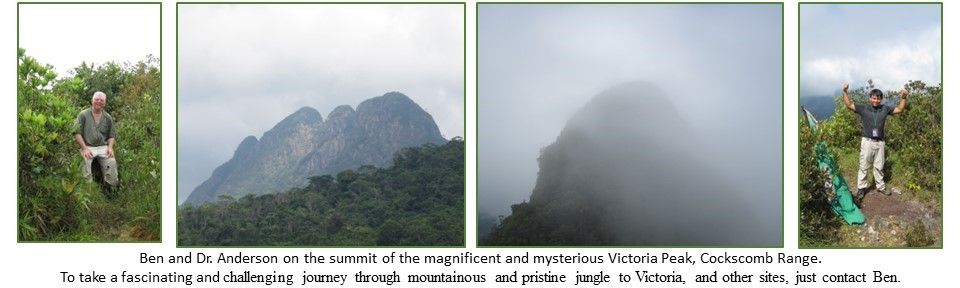
For a video of Ben and Dr. Anderson’s ascent to Victoria Peak, please go to the link below or to Expedition Bold III on YouTube to view on your TV or other device.
https://www.youtube.com/watch?v=Y-LQqrW4Mp4
The works by Dr. Henry W. Anderson are available as E-books and Print-on-Demand at BookBaby Bookshop, recommended, and other worldwide retailers. Go directly to: https://store.bookbaby.com/profile/jabirubooksbelizecom
Please note that our Newsletters and Excerpts of the Works of Dr. Henry W. Anderson are also published on our FaceBook page at https://www.facebook.com/JabiruBooksBelize
Visit our website at http://jabirubooksbelize.com.
Facebook: https://www.facebook.com/JabiruBooksBelize
Support Belizean Authors.
Jabiru Books Belize LLC thanks you for sharing/forwarding this Newsletter.
- © Jabiru Books Belize LLC
- Newsletter # 005.
- January 11, 2023
|