|
Mental Illness and the Works of Authors and Artists.
It is often difficult to prove a definite link between art and mental health, but it is not unlikely that psychological disorders can influence the creative work of authors and artists and their work may uniquely reflect their struggle and psychological condition. Unfortunately, some authors and artists affected by mental health issues have the misconception that the condition is the source of their creativity. In reality, those struggling with mental illnesses should seek help. Some famous writers and artists succumbed to an early death because they didn’t get the help they needed. In contrast, those who get help can live long lives and enjoy successful careers. Stephen King, J.K. Rowling and Anne Rice are a few examples of authors who’ve publicly spoken about their mental health issues. Whether dealing with depression or substance addiction, these authors sought help and have thrived.
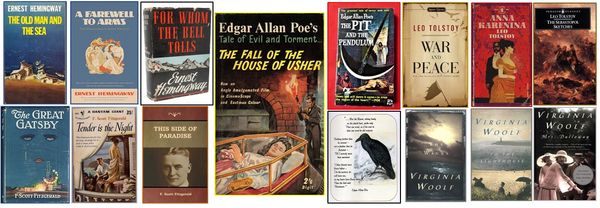
American novelist, short story writer, journalist, and Nobel Peace Prize in Literature recipient, Ernest Hemingway (1899 – 1961) achieved his success despite lifelong mental health issues. He was known as a heavy drinker and likely had an alcohol addiction. He did say: “An intelligent man is sometimes forced to be drunk to spend time with fools.” Along with alcoholism, Hemingway suffered from severe depression and his family had a history of depression; his father, brother and sister all committed suicide. In 1961, He received electroshock therapy, but died by suicide just a few days later.
Classic American short story author and poet, Edgar Allen Poe, (1809 – 1849) is often credited with creating the detective genre and frequently wrote dark, beautiful pieces. In a letter to a fan, Poe once wrote, “I became insane, with long intervals of horrible sanity.” Some of his most famous works include, “The Raven” and “The Tell-Tale Heart.” He suffered from chronic depression, possibly bipolar disorder, alcoholism and substance abuse. At one point, he reportedly tried to commit suicide by overdosing on laudanum. One year later, Poe died in a hospital from complications related to alcohol abuse.
Russian author Leo Tolstoy is considered one of the greatest writers of all time. From 1902 to 1906, he received nominations for the Nobel Peace Prize in Literature each year. His two most well-known books are, “War and Peace” and “Anna Karenina.” He suffered from alcohol abuse, depression, and thoughts of suicide. He wrote, “I did not myself know what I wanted: I feared life, desired to escape from it, yet still hoped something of it.” He died at 82 from pneumonia.
English novelist, essayist, and publisher, Virginia Woolf, (1882 – 1941) is given credit popularizing the stream of consciousness as a narrative device. Some of the more well-known novels include, “The Voyage Out,” “Mrs. Dalloway” and “Flush: A Biography.” She was a female rights advocate who wrote about the oppression of women. She once wrote,“As long as she thinks of a man, nobody objects to a woman thinking.” Her difficult childhood resulted in some lifelong mental health issues. In 1895, her mother died suddenly and she suffered a mental breakdown. A few years later, her half-sister died. She also experienced sexual abuse from her half-brothers during her childhood. As a result, she suffered from severe depression and mental breakdowns throughout her life. Despite becoming a successful writer, Woolf often saw herself as a failure. At the age of 59, she committed suicide by filling her pockets with stones and walking into a river.
American novelist, F. Scott Fitzgerald (1896 – 1940), author of “The Great Gatsby” and “The Curious Case of Benjamin Button,” published many books, short stories and essays during his lifetime. He once stated, “The world only exists in your eyes. You can make it as big or as small as you want.” He and his wife, Zelda, lived a fast-paced life full of parties and luxury, similar to his character Jay Gatsby. Zelda was also an author and was diagnosed with schizophrenia. Fitzgerald suffered from depression, alcoholism, and substance abuse. He died at the young age of 44 from a heart attack.
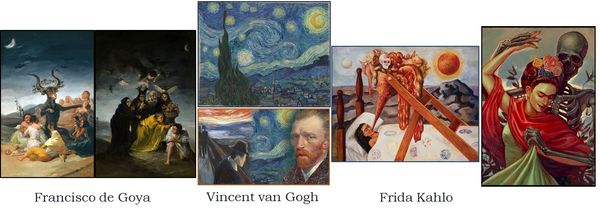
The Spanish artist Francisco de Goya, 1746 – 1828, became deaf in the year 1792 and the disease caused him to experience hallucinations, visual impairment, confusion, and partial paralysis. Theories suggest lead poisoning, syphilis, malaria, typhoid fever, and meningitis as possible diseases. The severity of his illness and the possible lead poisoning could have caused him to develop mental health problems such as depression, mood swings, and hallucinations.
The Dutch painter, Vincent van Gogh, 1853 – 1890, only painted for ten years, 1880 – 1890. He voluntarily entered an asylum in 1889 due to mental health. One of his most famous artworks, The Starry Night, 1887, was inspired by a landscape situated near the asylum. It is thought that he probably had bipolar disorder, borderline personality disorder, alcohol use disorder, and he suffered from psychotic episodes.
Mexican artist, Frida Kahlo, 1907 – 1954: Her art is known for depicting loss, pain, and trauma. At age 6 she was diagnosed with polio. At age 18, she was severely injured in a bus accident and suffered her whole life from pain due to her injuries. An emotional marriage led her to develop depression and even to attempt suicide and it is believed that she also suffered from post-traumatic stress disorder and bipolar disorder. Despite her various sufferings, Kahlo remained very strong-minded.

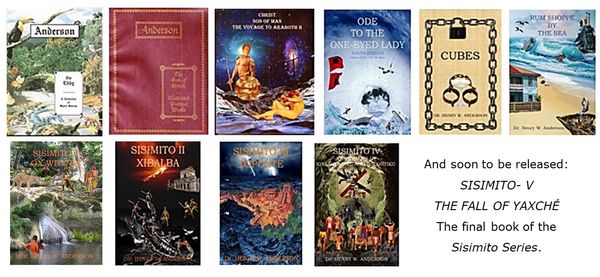
The works by Dr. Henry W. Anderson are available as E-books and Print-on-Demand at store.bookbaby.com (BookBaby Bookshop), recommended, and other worldwide retailers. Go to: https://store.bookbaby.com/profile/jabirubooksbelizecom
Please note that our Newsletters are also published on our FaceBook page at https://www.facebook.com/JabiruBooksBelize
Visit our website at http://jabirubooksbelize.com

|