|
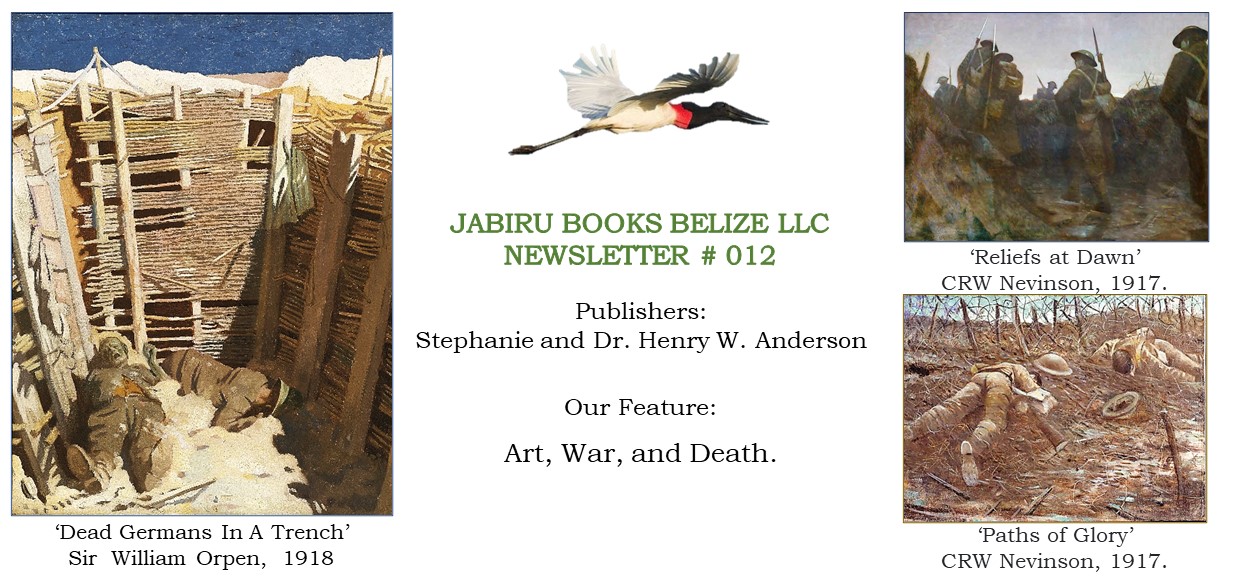
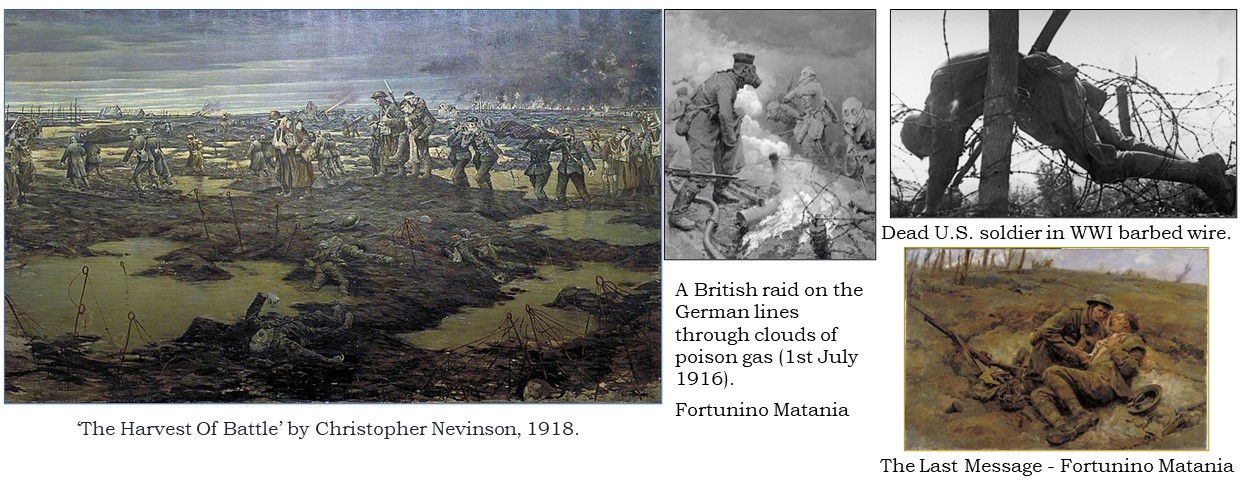
World War I World War I, also called First World War or Great War, was supposed to be the war to end all wars. As we know, that is not so. Even today, war prevails as criminal leaders are allowed to hold on to power and so destroy, murder, exercise cruelty, and endanger the safety of the entire world. World War I was an international conflict that in 1914–18 embroiled the nations of France, Great Britain, Russia, Italy, Japan, the United States from 1917, the Middle East, and other regions who fought against the Central Powers: mainly Germany, Austria-Hungary, and Turkey. It ended with the defeat of the Central Powers. The war was virtually unprecedented in the slaughter, carnage, and destruction it caused. Some 8,500,000 soldiers died as a result of wounds or disease during World War I. Perhaps as many as 13,000,000 civilians also died. This immensely large number of deaths dwarfed that of any previous war, largely because of the then new technologies and styles of warfare used in World War I. Pre-war military tactics that emphasized open warfare and the individual rifleman proved obsolete when confronted with conditions prevailing in 1914. Technological advances allowed the creation of strong defensive systems largely impervious to massed infantry advances, such as barbed-wire, machine guns and above all far more powerful artillery which dominated the battlefield and made crossing open ground extremely difficult. Both sides struggled to develop tactics for breaching entrenched positions without suffering heavy casualties. In time, however, technology began to produce new offensive weapons, such as gas warfare and the tank. Trench life involved long periods of boredom mixed with brief periods of terror. The threat of death kept soldiers constantly on edge, while poor living conditions and a lack of sleep wore away at their health and stamina. Rats and lice tormented the troops by day and night. Oversized rats, bloated by the food and waste of stationary armies, helped spread disease and were a constant irritant. In 1918, doctors also identified lice as the cause of trench fever, which plagued the troops with headaches, fevers, and muscle pain. The unsanitary conditions of trench life, especially the cold, persistent dampness, resulted in trench foot, a frost-bite-like infection that in extreme cases, led to gangrene and amputation. Random shelling and sniping characterized trench warfare, with earth-shattering or deadly rifle shots periodically breaking the boredom of trench life. The enemy remained largely hidden from view and soldiers often felt powerless against arbitrary and sudden death. The inability to defend oneself against shelling or snipers, and the constant hardships of trench life, contributed to extreme stress and exhaustion. Dozens, sometimes hundreds, of soldiers were killed and wounded each day. The infantry and machine-gunners, which took the majority of casualties during the war, planned to lose 10 percent of the total strength each month to death, wounding, and illness. The killing never stopped. At the start of the war, at sea, German cruisers were scattered across the globe, some of which were subsequently used to attack Allied merchant shipping. German U-boats attempted to cut the supply lines between North America and Britain. The nature of submarine warfare meant that attacks often came without warning, giving the crews of the merchant ships little hope of survival. 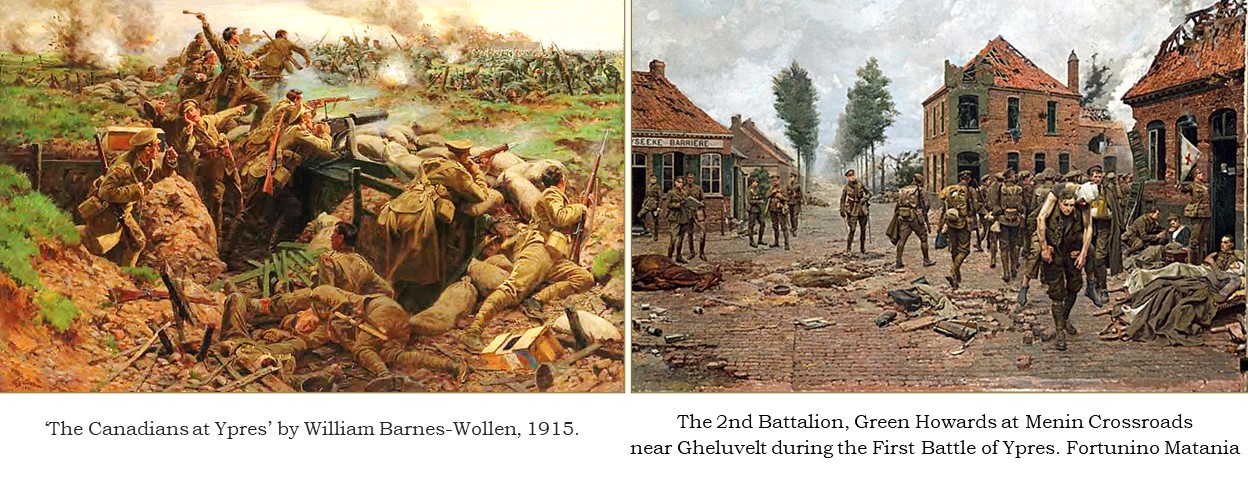
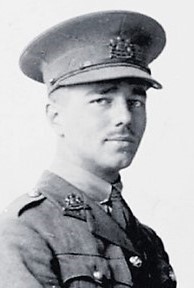
Lieutenant Wilfred Edward Salter Owen Wilfred Edward Salter Owen was born on March 18, 1893, in Oswestry, on the Welsh border of Shropshire, in the beautiful and spacious home of his maternal grandfather. He is regarded as having written the best British poetry on World War I. He composed nearly all of his poems in slightly over a year, from August 1917 to September 1918. In November 1918 he was killed in action at the age of 25, one week before the Armistice. In this preface Owen said that the poetry in his book would express “the pity of War,” rather than the “glory, honour, might, majesty, dominion, or power,” which war had acquired in the popular mind By May 1918 Owen regarded his poems not only as individual expressions of intense experience, but also as part of a book that would give the reader a wide perspective on World War I. In the last weeks of his life Owen seems to have coped with the stress of the heavy casualties among his battalion by “insensibility,” much like that of soldiers he forgives in his poem of the same title, but condemns among civilians: “Happy are men who yet before they are killed Can let their veins run cold.” These men have walked “on the alleys cobbled with their brothers.” One of Owen’s most moving poems, “Dulce et Decorum Est,” which had its origins in Owen’s experiences of January 1917, describes explicitly the horror of the gas attack and the death of a wounded man who has been flung into a wagon. The horror intensifies, becoming a waking nightmare experienced by the exhausted viewer, who stares hypnotically at his comrade in the wagon ahead of him as he must continue to march. 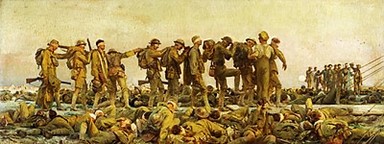
‘Gassed’ by John Singer Sargent, 1919. Dulce et Decorum Est Bent double, like old beggars under sacks, Knock-kneed, coughing like hags, we cursed through sludge, Till on the haunting flares we turned our backs, And towards our distant rest began to trudge. Men marched asleep. Many had lost their boots, But limped on, blood-shod. All went lame; all blind; Drunk with fatigue; deaf even to the hoots Of gas-shells dropping softly behind. Gas! GAS! Quick, boys!—An ecstasy of fumbling Fitting the clumsy helmets just in time, But someone still was yelling out and stumbling And flound’ring like a man in fire or lime.— Dim through the misty panes and thick green light, As under a green sea, I saw him drowning. In all my dreams before my helpless sight, He plunges at me, guttering, choking, drowning. If in some smothering dreams, you too could pace Behind the wagon that we flung him in, And watch the white eyes writhing in his face, His hanging face, like a devil’s sick of sin; If you could hear, at every jolt, the blood Come gargling from the froth-corrupted lungs, Obscene as cancer, bitter as the cud Of vile, incurable sores on innocent tongues,— My friend, you would not tell with such high zest To children ardent for some desperate glory, The old Lie: Dulce et decorum est Pro patria mori. Latin phrase is from the Roman poet Horace: “It is sweet and fitting to die for one’s country.” Two of his other poems are: Anthem for Doomed Youth: “What passing bells for these who die as cattle? Only the monstrous anger of the guns. Only the stuttering rifle's rapid rattle Can patter out their hasty orisons. No mockeries now for them; no prayers, nor bells, Nor any voice of mourning save the choirs, The shrill demented choirs of wailing shells, And bugles calling for them from sad shires. What candles may be held to speed them all? Not in the hands of boys, but in their eyes, Shall shine the holy glimmers of goodbyes. The pallor of girls' brows shall be their pall, Their flowers the tenderness of patient minds, And each, slow dusk a drawing down of blinds.” Bugles Sang Bugles sang, saddening the evening air; And bugles answered, sorrowful to hear. Voices of boys were by the river-side. Sleep mothered them; and left the twilight sad. The shadow of the morrow weighed on men. Voices of old despondency resigned, Bowed by the shadow of the morrow, slept. Here are some quotes from his other poems: “Red lips are not so red as the stained stones kissed by the English dead.” “He's lost his colour very far from here, Poured it down shell-holes till the veins ran dry” “I dreamed kind Jesus fouled the big-gun gears; And caused a permanent stoppage in all bolts; And buckled with a smile Mausers and Colts; And rusted every bayonet with His tears.” “I am the enemy you killed, my friend.” 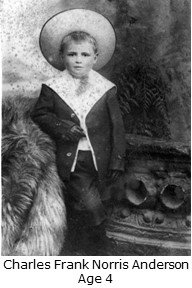
Private Charles Frank Norris Anderson, Uncle to Dr. Henry W. Anderson, was born in Belize, then British Honduras, July 31, 1897. As a war-time volunteer, he joined the Essex Yeomanty in 1915 and later transferred to the Essex regiment. It is likely that he only joined his battalion, 9th Battalion Essex Regiment, in the weeks leading up to the Battle of Arras in 1917. He was killed in the attack towards Monchy le Preux on 9th April 1917. He has no known grave and is commemorated on the Arras Memorial. He was 19 years old. His name is included on a plaque at the Memorial Park, Belize City. 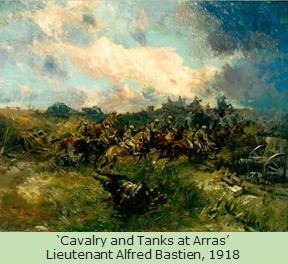
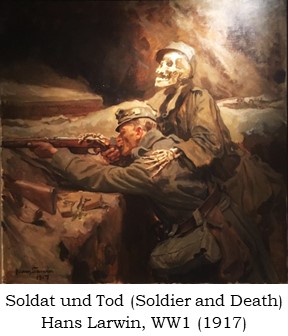
The Lonely Soldier by Dr. Henry W. Anderson I crouch down On the dirty slush Of wet, wet ground. All is sodden; yet, The rains pour on From a heavy heaven. Everywhere is dark And I am alone, Except for my friend— My cold triggered friend. Everywhere is fear For Death lingers near. I feel Death with every breath, With every sound, with every shadow. I know, It won’t be long I’ll be dead; And, no one will know, No one will lay me to rest, For I am in a strange land Beyond the frontiers of friendship. Why do I torture, Waiting only? Make it easy, dear Death, One bullet find me. 1 feel cold But I shiver not. Perhaps I’m colder than the rain. I must go on. To sit and wait for Death is Death itself. There is a chance, Though slim, I may yet walk across the lines . . . Or do I dream Like men when all is lost? Oh! Fools to dream of better times When Life is almost done. I slowly rise and I walk on. ‘Tis strange how Fate will have her way. Is she stronger than He? This is blasphemy! But . . . who questions not When he faces Death And wants him not? And on I go, Muddied step by step, Waiting only For what I know will come. Oh Death, Should you beckon, Come soon and swift I beg thee. From the book: The Son Of Kinich – Illustrated Poetical Works. Published 1995 by Jabiru Books. BOOKS ALREADY PUBLISHED 
The works by Dr. Henry W. Anderson are available as E-books and Print-on-Demand at store.bookbaby.com (BookBaby Bookshop), recommended, and other worldwide retailers: E-Book Retailers: Amazon, Barnes & Noble, Apple Books, Vearsa, Kobo, OverDrive, Copia, Gardners Books, Baker & Taylor, eSentral, Scribd, Ciando, hoopla, Playster, and many more. Print-on-Demand Retailers: Amazon, Barnes & Noble, Powell’s and thousands of other stores and wholesale bookstore catalogs like Ingram and Baker & Taylor, around the world. For store.bookbaby.com, go to: https://store.bookbaby.com/profile/jabirubooksbelizecom Please note that our Newsletters are also published on our FaceBook page at https://www.facebook.com/JabiruBooksBelize Visit our website at http://jabirubooksbelize.com 
|