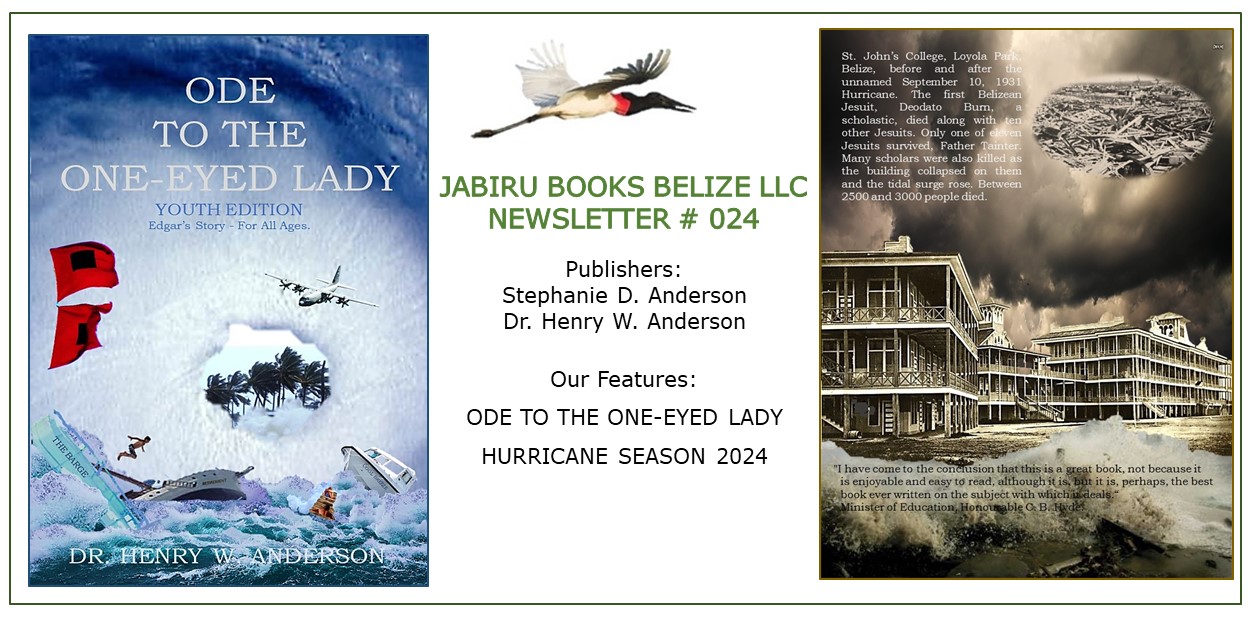
 ODE TO THE ONE-EYED LADY -YOUTH EDITION 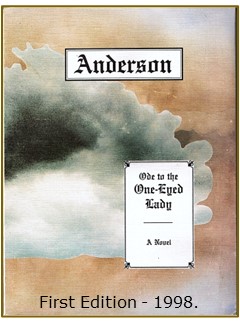 The First Edition of Ode To The One-Eyed Lady states: Richard Leslie greatly anticipated his getaway to the exotic coral island on the barrier reef where his family awaited him. Yet, recurrent dreams of his recent unfaithfulness, combined with a devious plot to steal his rights to the island, destroyed the beauty and serenity of the tropical splendour. Even more devastating was the nightmare soon to be unleashed upon him and his family–a nightmare of horror as a Grade V hurricane approached, bent upon destroying them. The ‘Youth Edition’ tells the story as it was experienced by twelve-year-old Edgar Leslie. Adult themes have been removed in this edition; yet, this book is written to be read by all ages. Edgar invites you to read his story, as follows: “My name is Edgar Leslie and I am twelve years old, soon to be thirteen. My father’s name is Richard and he is 35 years old. My mother is Emma and she is 30. I have two sisters and a brother. Natasha is 9, Gabriel is 6, and Erika is 3. I will tell you a story, an amazing story, a terrible story, most of which I experienced myself, trapped on a beautiful island off the coast of Belize. Other happenings were told to me, at a later date, and I tell them to you as they are about incidents that relate to the hurricane. I must thank those who assisted me in bringing together my story about a lady, a powerful One-Eyed-Lady named Dorothy, Hurricane Dorothy.” Synopsis: It is August, hot and breathless, and Edgar Leslie and his family are spending their vacation on the island of Frangipani Caye, off the coast of Belize. After a few days, Hurricane Dorothy develops in the Caribbean and grows into a major hurricane as it approaches the coastline of Belize. They begin their preparations to leave the island, but become trapped because of a boating accident. There, they endure the ferocity of the hurricane, her winds and high water, in an unbelievable struggle for survival. Ode To the One-Eyed Lady is not only about Edgar and his family’s endurance, but also provides very important information on hurricanes in the Front Material, including Belize’s Hurricane Plan, a hurricane tracking chart, and other interesting material. There are also 38 illustrations. The Appendix carries information on hurricanes that have crossed the coastline of Belize, or near, during the period 1931 - 2017. Included are tracking charts and photographs. Read about hurricanes like Francelia 1969, Carmen and Fifi 1974, Greta 1978, Gert 1993, Keith 2000, Iris 2001 - 145 mph, Dean 2007, Richard 2010, Earl 2016, and many others. C. B. Hyde wrote, “I have come to the conclusion that this is a great book, not because it is enjoyable and easy to read, although it is, but it is, perhaps, the best book ever written on the subject with which it deals.” An illustration from Ode To the One-Eyed Lady – Youth Edition: The Calm Before The Storm. 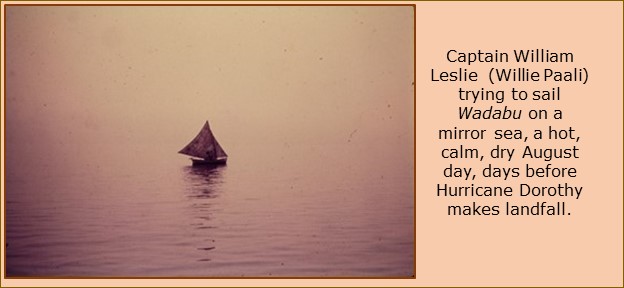 Ode To The One-Eyed Lady – Youth Edition can be ordered directly at: Print-on-Demand: https://store.bookbaby.com/book/ode-to-the-one-eyed-lady-youth-edition E-Book: https://store.bookbaby.com/book/ode-to-the-one-eyed-lady-youth-edition1 For ordering Dr. Anderson’s other books, go to: https://store.bookbaby.com/websearch/index.aspx?searchterms=henry+w+anderson Books are also available at other worldwide retailers and at the Belize National Library Service and Information System REMEMBERING SOME MAJOR HURRICANES 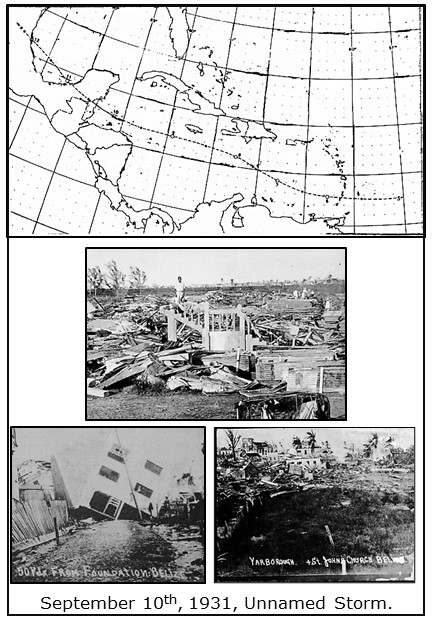 Five storms affected Belize in 1931, one of which was the infamous September 10 Hurricane which destroyed Belize City and killed near three thousand people. It is interesting to note that this storm did not become a hurricane until after it passed Swan Island, less than 250 miles east of Belize City. The cyclone intensified to hurricane intensity by September 8. Strengthening and organization remained gradual until the storm reached the Gulf of Honduras, by which time it began to rapidly intensify, reaching Category 4 hurricane intensity on September 10. The center passed north of Belize City placing the City in the southern eye-wall and not the north-eastern which is normally more devastating. Also noteworthy is that Tropical Storm 6 passed just north of Corozal on September 14, only 4 days later. 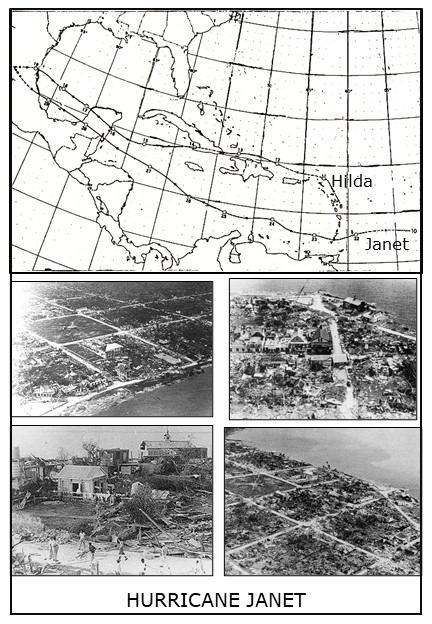 Janet formed from a tropical wave east of the Lesser Antilles on September 21, 1955. Moving westward across the Caribbean Sea, Janet fluctuated in intensity, but generally strengthened before reaching its peak intensity as a Category 5 hurricane with winds of 175 mph (282 km/h). The intense hurricane later made landfall at that intensity near Chetumal, Mexico, and Corozal, Belize, then British Honduras, on September 28. A Category 5 upon landfall on the Yucatán Peninsula, Janet caused severe devastation in areas Only five buildings in Chetumal remained intact after the storm, and an estimated 500 deaths occurred in Quintana Roo. An anemometer at the airport in Chetumal reported winds of 175 mph before being blown away. Janet was the first named storm to cause 1,000 deaths and the first Category 5 storm name to be retired. Hurricane Hilda had passed North of Corozal on September 16 to be followed by Hurricane Janet on September 28, only eleven days later. 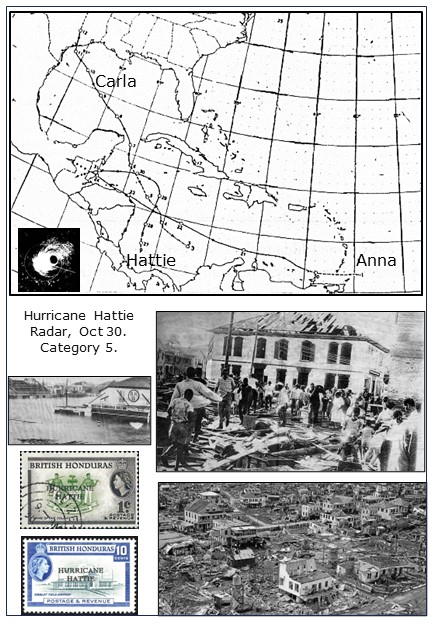 Hurricane Hattie began east of Nicaragua on the 27 October, 1961, and by the 31st had become one of the most powerful Caribbean hurricanes for that century. With winds sustained at 150 m.p.h., tides of 20 feet, and travelling less than 5 mph, Hattie devastated Central Belize. Hattie made landfall at Mullings River, just north of Dangriga (Stann Creek Town), destroying that town and Belize City, causing over 300 deaths and millions in damages. Earlier that Hurricane Season, Anna crossed the coast line near Dangriga. In September, Carla threatened, but did not make landfall. 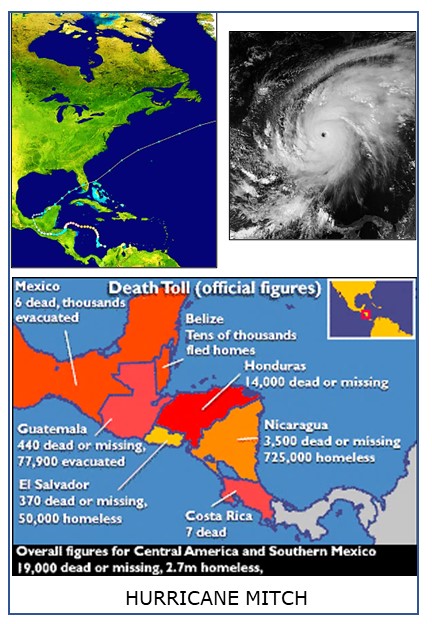 Hurricane Mitch: Peak Intensity: 180 MPH (285 km/h) 905 mbar: Tropical Depression Thirteen was spawned by a tropical wave on October 22, while located offshore Colombia in the Caribbean Sea. Later that day, the depression became Tropical Storm Mitch, the name having been used since 1950, and within two days it intensified into a hurricane. While curving westward, the storm rapidly deepened, reaching its peak as a Category 5 hurricane with winds of 180 mph (285 km/h) and a minimum pressure of 905 mbar (26.7 inHg) late on October 26. Mitch weakened significantly while turning to the south, and on October 29 it moved ashore with winds of 80 mph (130 km/h) east of La Ceiba, Honduras. In Belize, although Mitch did not come closer than 150 miles, huge swells generated by the hurricane crossed the barrier reef, covering islands and destroying structures. There was no loss of life as most islands had been evacuated. Dr. Anderson mother’s house at South Water Caye was thrown off its posts. HURRICANE SEASON 2024 The 2024 Atlantic hurricane season officially began June 1 and runs through November 30, although there can be hurricanes off-season. The Eastern Pacific hurricane season is two weeks longer, starting May 15. Based on historical averages, a typical Atlantic hurricane season has 14 named storms. The 2024 season could double that. Hurricane Season Predictions 2024: (1) National Hurricane Center (NHC): The NHC is predicting there is an 85% chance of an above-normal season, a 10% chance of a near normal season and a 5% chance for a below normal season. 17-25 named storms 8-13 hurricanes 4-7 major hurricanes A major hurricane is a Category 3 storm or higher, with maximum sustained winds of at least 111 mph. (2) Accu Weather: Forecasters are warning that the season could break the 2020 record of 30 named storms. 20-25 named storms 8-12 hurricanes 4-7 major hurricanes 4-6 direct U.S.A. impacts (3) Colorado State University: CSU 2024 Atlantic Hurricane Season forecast calls for 23 named storms 11 hurricanes 5 major hurricanes BELIZE: BE PREPARED NOW. Please note that although there will be information available on TV stations like The Weather Channel, it is important to keep updated with your own National Meteorological Service of Belize as the NMSB is able to provide local and up-to-date information like no one else can. Beware of Social Media. Publisher’s Note: Should you wish to comment on our Newsletters, offer suggestions, please go to our Website and to the ‘Contact’ button. BOOKS WRITTEN BY DR. HENRY W. ANDERSON 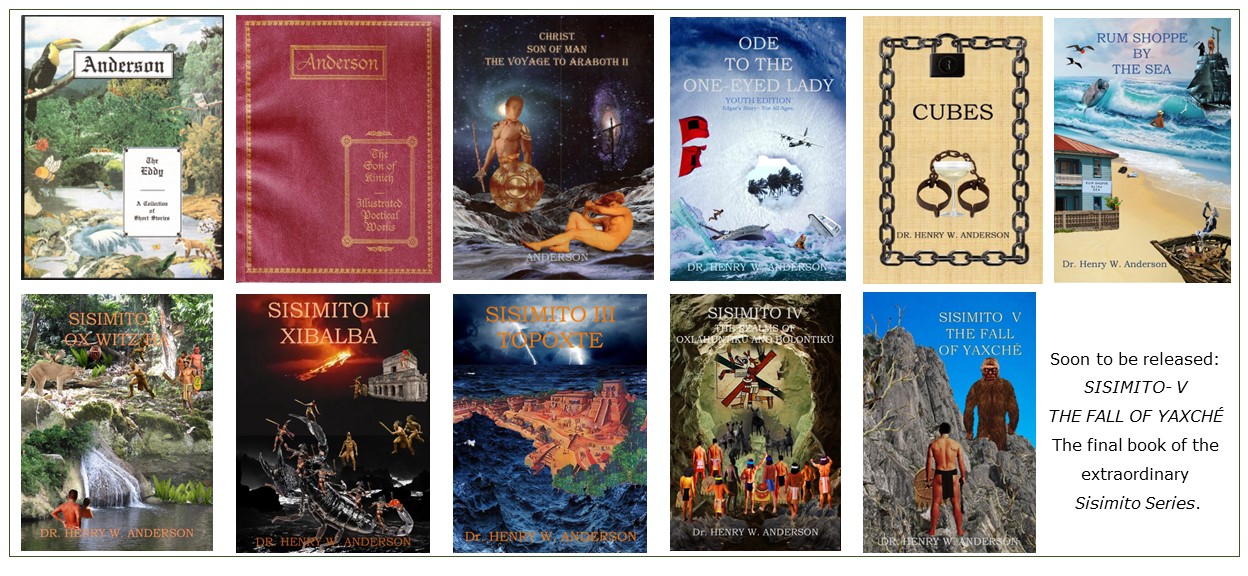 INFORMATION/LINKS The works by Dr. Henry W. Anderson are available at the libraries of the Belize National Library Service and Information System. For more information, please go to: https://www.bnlsis.org/ Once on the website, you may go to ‘Public Library Catalogue’ then to ‘Subject;’ select ‘Author’ and put in Henry Anderson; or use the link below to go directly to Dr. Anderson books: https://bnlsis.mlasolutions.com/m5/catalog/(S(tsaodaxofc2mvp3zhpl4wwt2))/Default.aspx?internal=1&installation=LeoBradley Dr. Henry W. Anderson books are also available as E-books and Print-on-Demand at store.bookbaby.com (BookBaby Bookshop), recommended, and other worldwide retailers: E-Book Retailers: Amazon, Barnes & Noble, Apple Books, Vearsa, Kobo, OverDrive, Copia, Gardners Books, Baker & Taylor, eSentral, Scribd, Ciando, hoopla, Playster, and many more. Print-on-Demand Retailers: Amazon, Barnes & Noble, Powell’s and thousands of other stores and wholesale bookstore catalogs like Ingram and Baker & Taylor, around the world. For store.bookbaby.com, go to: https://store.bookbaby.com/profile/jabirubooksbelizecom If you know someone who would like to receive our monthly Newsletter, please have them go to CONTACT at our website and send us an e-mail. Please note that our Newsletters are also published on our FaceBook page at: https://www.facebook.com/JabiruBooksBelize Visit our website at http://jabirubooksbelize.com 
.
|