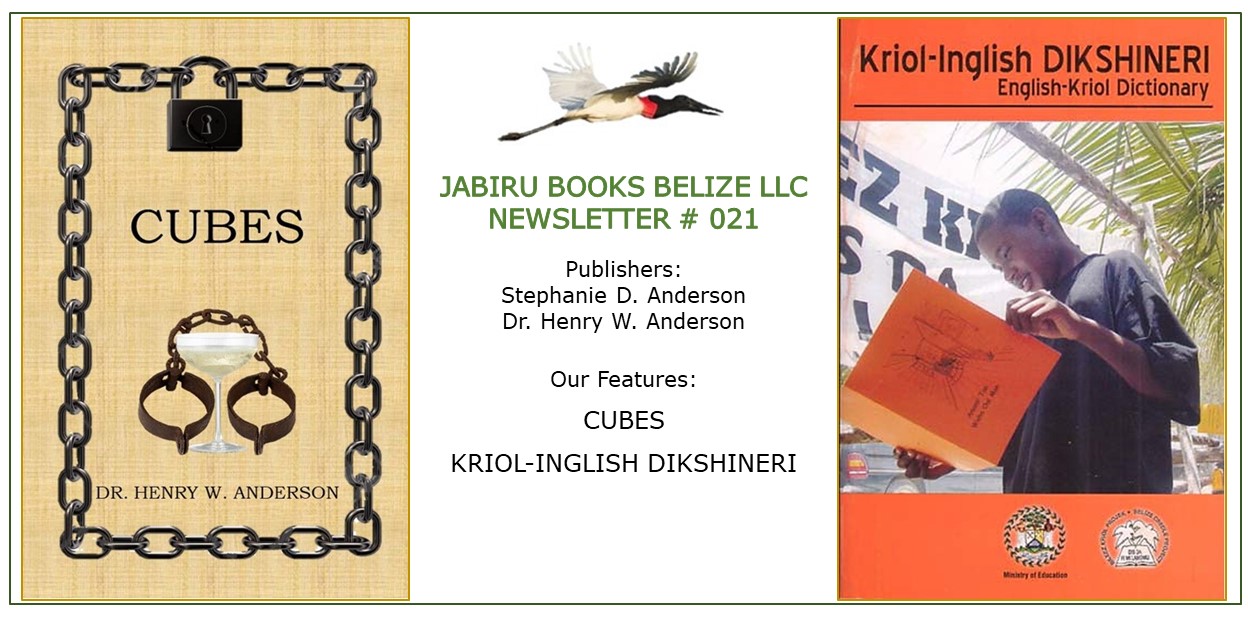
 CUBES The Recurring Theme: Stop The Flow. (Stop the flow refers to stopping the drinking of champagne by the Rich at the bow of their yachts. Generally, the flow also refers to the social and financial injustices practiced by Corporate-USA and the Rich upon lower income brackets of society.) CUBES is not meant to condemn, but to provoke thought. CUBES is dedicated to the Middle Class of the USA, The Silent Sleeping Society, and is set in the Work-Cube of a Call Center. The book deals with issues of importance and relevance in today’s United States of America, is thought stimulating and may even be considered agitative; yet, it can be humourous, light, sad, worrying. CUBES delves into the plight of the Indigenous Peoples of America, suppression by Corporate-USA and the Wealthy, Democratic Socialism and Unionism, the state of Mental Health treatment, the high cost of Medical Care, the Pandemic, Abuse of Freedom and the Constitution, Slavery, the Deterioration of Society, Immigration and the role of the USA in its origin, the past Wars of Central America, the Revolution in Cuba, untruthful History, Politics and Politicians, Advertising and wasteful spending, trauma in the Workplace, many other topics, even Poetry and a Prince, all set within the framework of the Work-Cube. It is a book that will invite one to look at one’s life and the role one plays in these United States of America. For international readers, CUBES will make one examine one’s own Society. CUBES is a book you must read. The State of the Nation address, 2023, to a joint session of Congress and the peoples of the United States of America incorporated many of the topics covered in Dr. Henry Anderson’s book, CUBES. These issues are most current and deal with subjects every citizen and resident of the United States of America must recognize and play their part in addressing. Some of the concerns dealt with in that speech and that are in CUBES are: The Rich and Corporate America not paying their share of taxes and the urgent need to correct the unfair tax system now in place; The need for Unionized Labour and the need for fair wages; The urgency of closing the gap between the rich and the poor; The need for financial stability of the Middle Class and the role that financial stability will play towards uplifting the poor; The lowering of the cost of prescription medicines and control over the large profits pharmaceutical companies are making; The need for greater availability of Mental Health Care; The urgency for the banning of assault weapons; Police reform; Immigration; Many other serious issues affecting our Society: Some Excerpts From CUBES Published 2021 C: Caller CSR: Customer Service Representative The First Caller: Tahatan. The Lakhóta. A Historian: C: “The worst thing you can call a Lakhóta is selfish for generosity is one of the cardinal virtues of the Lakhóta culture; actually, for all the Peoples of the Indigenous Nations. This generosity was never and is still not returned by the Invaders. Poverty on the Reservations has led to broken families, alcoholism, drug-abuse, violence, high crime rates, poor health, suicides, and a constant struggle to be able to live a good life; these are things that were not know to us until the Invaders set foot in our land and took it away from us. Now we are societies of poverty sitting amidst rich states.” The Second Caller: Benjamin. The Local. A Customer Service Representative Hopeful: CSR: “To get ahead in Corporate-USA, you must be ready and willing to leap over the dead backstabbed bodies of your co-workers. No opportunity must be missed. If you can’t do this, then Corporate-USA is not for you.” The Third Caller: Eratosthenes. The Greek. A Geographer: C: “World-Geography is not given precedence in schools because it is thought best not to have our students realize that other countries, other that the USA, really do exist and there are some that are not only bigger, but greater than we are.” The Fourth Caller: Indira. The Indian. An Aspiring Politician. CSR: “A poor person can certainly run for office and win and I’m not engaging in probabilities here. The real issue is whether a poorly-funded candidate can win. Money is the lifeblood of politics, I must say. As is said, Congress is an exclusive club and a wealthy one. Even on a local level, being able to afford mailing and some signs can put you ahead of an opponent. And, you have to know how to raise money.” C: “Money! Always money!” The Fifth Caller: John. The Englishman. The Poet: C: “Ooh-la-la! What about shit?” CSR: “We use the Latin word, stercore.” C: “Doesn’t sound like shit to me.” CSR: “Please. Do not use the ‘S’ word. Use stercore.” C: “I can't understand how some people think. The ‘S’ word is just an interjection, used all over the world, by everyone, all ages. Of course, in some languages it may be different. In Belize, the Kriol word is kaka, as it is in the Basque Region of Northern Spain. The Spanish say mierda, the French merde. For Hmong, Lao, Myammar, Swahili, Zulu, Maori, it's shit. Plain old ‘shit.’ I don't know. stercore just doesn't come across as ‘shit’, I think kaka would be a better word.” The Sixth Caller: Emelia. The German. A Future Psychologist: C: “You’re probably suffering from Dissociative Identity Disorder. It used to be called Multiple Personality Disorder. It is a mental disorder characterized by the maintenance of at least two distinct and relatively enduring personality states. The disorder is accompanied by memory gaps as you have already demonstrated by calling me Emily instead of Emelia. I will need to ask you some very personal questions to see if we can identify what traumatic factors may have caused this illness, although I do suspect what it is.” CSR: “I will stop this line of conversation. I am not crazy . . .” C: “We do not use that terminology anymore.” CSR: “Well, right now, you have me feeling quite crazy.” C: “That’s what we have been discussing.” The Seventh Caller: Igo. The Nigerian. A Historian. C: “Have you heard about Igbo Landing?” CSR: “No! I haven’t.” C: “I suppose that was a part of USA history that you were not taught in school. USA students are not being taught the full truth about slavery, only a sanitized version of the atrocities suffered by slaves in this nation and others, taught only a deeply incomplete version of events. That’s why, Alfred, you and others have not heard about Igbo Landing. It is a historic site in Georgia, the site of one of the largest mass suicides of enslaved people in history. The Igbo captives were from my country, Nigeria, and were purchased for an average of $100 each by slave merchants John Couper and Thomas Spalding. The Igbo and other West African captives arrived in Savannah, Georgia on the slave ship Wanderer in 1803 and were to be resold to plantations on nearby St. Simons Island. “The chained captives were packed under the deck of a coastal vessel, York, which would take them to St. Simons. During the voyage, approximately 75 Igbo slaves rose in rebellion, took control of the ship, drowned their captors, and in the process caused the grounding of the ship in Dunbar Creek. The captives marched ashore, singing, led by their High Chief. Then at his direction, they walked into the marshy waters of Dunbar Creek, committing mass suicide. Now, you know about Igbo Landing.” The Eight Caller: Leonetto. The Frenchman originally from Italy. The Advertiser: CSR: “As I said twice before, Leonetto, sometimes, in order to survive, one has to put aside things that upset you, at least for a time, until those things can be handled better. You may have to do that.” C: “I try, Alfred, but when advert producers are allowed to get away with things they shouldn’t, they begin to believe, or have always believed, that no one can stop them. I think the most upset I have ever been about the callousness of TV Adverts was the one for Thursday Night Football. Can you believe that they used the Last Supper? The producers were using the Last Supper to advertise USA-Football. They were using the suffering and blood of Jesus Christ to advertise USA-Football. They were using His personal suffering in Gethsemane, the Crown of Thorns pierced into His head, the 39 lashes across His back, the walk and falls carrying the cross to Cavalry, the Lamentation of His Mother, the spikes in His hands and feet, the lance in His chest. They used the Death and Suffering of Jesus Christ to promote Thursday Night Football. (Pause.) C: “One beer company has even used His name on a beer.” The Ninth Caller: Simón. The Venezuelan. The Freedom Fighter: C: “It’s hard to believe that there are so many second and third-generation Cubans living here in the USA who do not know why the Cuban Revolution came about and prefer to remain in their ignorance, listen to their grandparents that fled Cuba, blaming Castro instead of praising Castro for doing what was right for the ordinary man.” CSR: “A lot has been said about Cuba and Castro, still is. I think, however, the actual facts remain unclear.” C: “Intentionally so by USA propaganda and those who supported the Oppressors.” The Tenth Caller: D’Andre Miguel. The Jamaican. The Reggae-Man: CSR: “So, you’re Jamaican. Are you also a USA citizen?” C: “Yes, Man, but Jamaican to mi backbone. Solid Jamaican foundation to build this other citizenship on. Yes, I’m an immigrant, but I haven’t been saying it out loud lately even though I can’t hide how I look. And they know as soon as I open mi mouth.” CSR: “Why would you want to hide that you’re an Immigrant?” C: “You must be really locked up eena yu Cube. Don’t you hear all the talk about immigrants and immigration? Talk about ‘wall this and wall that’? Where you living, Man?” The Eleventh Caller: Kevin Frank. Local. The Posterman: C: “Why don’t you have the Obama tee-shirt as well as the poster? Afraid to wear it? You don’t have to be afraid anymore. That Man Who Vacated The White House done gone on Air Force One.” CSR: “No. I’m not afraid. I just preferred the poster.” C: “Couldn’t afford both?” CSR: “No. I just preferred the poster.” C: “Do you know what the OBEY brand is well-known for?” CSR: “A good tee-shirt?” C: “Low and behold. How we dance in ignorance and there’s always someone playing the music.” The Twelfth Caller: Nala Arlene. Local. The Unionist: C: “The USA, according to World Bank, has some of the worst income inequality in the developed world and the problem is getting much worse. There is globalization, the process by which businesses or other organizations develop international influence or start operating on an international scale. There is deregulation, that is the removal of regulations or restrictions, especially in a particular industry. Of great concern to me, among other things, and it should be to you and all workers, Cubed or not, is the decline of workers’ unions and the exorbitant executive compensation packages. You may not want to believe this, Alfred, but this is what is happening in this Great Nation of ours. A recent report found that the average CEO pay at the 350 largest USA companies climbed by over 1,000 percent in the last 40 years. Meanwhile, wages for the average worker climbed by less than 12 percent. Twelve percent as opposed to 1,000 percent. Is that what happens in a Great Nation? One must ask, is that the cost of Capitalism? What this shows is a nation at its worst, and it will get worse for we allow CEOs to live in estates that cost $110 million while other citizens live in the tents of the homeless. The USA is known as ‘the land of opportunity.’ It has become ‘the land of opportunity for the Rich.’ We know that distribution of incomes is less evenly distributed than they were 20 or 30 years ago, but it is not only the distribution of income that should concern us; it is the system that produces that unequal distribution. That is the issue. But we sit in our little Cubes and continue the flow.” To purchase CUBES, Print-on-Demand and E-Book, go to: https://store.bookbaby.com/book/cubes CUBES is also available at other international retailers Kriol-Inglish Dikshineri – English-Kriol Dictionary This is a bilingual dictionary. The main part, Kriol to English, is arranged alphabetically according to Kriol key words, with an English definition and other entry items, such as part of speech, sample sentences, etymology, and cross-references. The second part of the dictionary, English to Kriol, is arranged alphabetically according to the English key words, with the correlating Kriol word(s). It serves to direct the reader to the correct spot in the Kriol section for more complete information. The front of the book features a Foreword by Sir Colville Young, a Guide to Using the Dictionary, a guide to the Kriol Writing System and Grammar Notes. Compiled and edited by Yvette Herrera, Myrna Manzanares, Silvaana Udz, Cynthia Crosbie, and Ken Decker; with Paul Crosbie as editor-in-chief. Published by the Belize Kriol Project 2007, with the help of The National Kriol Council, The Ministry of Education and the National Institute of Culture and History, and SIL International. Printed at Print Belize. Available in Belize City from Bible Society Bookstore, Angelus Press, Brodies Northern Highway, Image Factory, National Handicraft Center and the National Kriol Council Office. National Kriol Council From the Kriol-Inglish Dikshineri: 1) Creole–The ethnic group: Traditionally in the colonies, people born of European or African descent or a mixture of both; today in Belize, the term refers specifically to anyone with any mixture of African and any other ancestry. Di Kriol eena Bileez ga lat a difrant kala; fahn blak blak tu wait wait – ahn noh mek wi figit dehn red gyal ahn bwai! Creoles in Belize have many different colours; from very black to very white – and let’s not forget the red-skinned guys and gals. 2) Creole: A language born from the contact of primarily English-speaking colonial masters, and slaves who spoke a variety of West African languages; Belize Kriol consists of vocabulary that is primarily English-based, and a grammatical system that follows West African patterns. Evribadi tink seh ih haad fi laan fi reed Kriol, bot ih eezi. Everybody thinks that it’s hard to learn to read Kriol, but it’s easy. Ah tel mi ma fi chrai laitn ih tong, bot shee oanli taak loan braad Kriol. (Braad Kriol n.phr. broad, unrefined Kriol.) I told my mom to try to refine her speech, but she speaks only unrefined Kriol. 3) Creole Culture refers to the people, language, or culture. Ah laik goh da di Kriol festival fi eet sehreh ahn tablayta, ahn daans tu boom ahn shain myoozik, ahn laan moa bowt wi hischri. I like to go to the Creole Festival to eat fish stew and coconut candy, dance to boom and chime music, and learn more about our history. Kriol-Inglish Dikshineri is also available on line, free of cost. Go to the link below for access: https://www.sil.org/system/files/reapdata/91/95/49/91954925699176285931841170600318709537/BelizeKriol_EngDic_49337_2009.pdf Interesting Facts about Creole/Kriol. The English word ‘creole’ derives from the French créole, which in turn came from Portuguese crioulo, a diminutive of cria meaning a person raised in one's house. Cria is derived from criar, meaning "to raise or bring up", itself derived from the Latin creare, meaning "to make, bring forth, produce, beget"; which is also the source of the English word "create". It originally referred to the descendants of European colonists who had been born in the colony. Creole is also known by cognates in other languages, such as crioulo, criollo, creolo, créole, kriolu, criol, kreyol, kreol, kriol, krio, and kriyoyo. Belizean Creoles, also known as Kriols, are a Creole ethnic group native to Belize. They are primarily mixed-raced descendants of West and Central Africans who were brought to British Honduras (Belize) and the English and Scottish log cutters known as the Baymen. Over the years they have also intermarried with the Miskito from Nicaragua, Jamaicans and other Caribbean people, Mestizos, Europeans, Garifuna, Maya, Chinese, Indians who were brought to Belize as indentured laborers, and many other peoples. The majority of Kriols trace their ancestry to several of the aforementioned groups. Belize Kriol developed initially by interaction among the Africans and Europeans and was historically spoken only by them.
In Alaska, the Alaskan Creole, sometimes colloquially spelled "Kriol" in English (from Russian креол), are a unique people who first came about through the intermingling of Sibero-Russian promyshenniki men with Aleut and Eskimo women in the late 18th century and assumed a prominent position in the economy of Russian America and the North Pacific Rim. In Cape Verde, the dominant ethnic group, are called Kriolus or Kriols in the local language; the language itself is also called Creole. Wikipedia Publisher’s Note: Should you wish to comment on our Newsletters, offer suggestions, please go to our Website and to the ‘Contact’ button. BOOKS WRITTEN BY DR. HENRY W. ANDERSON 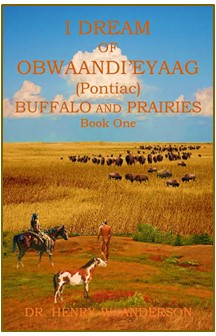
The initial manuscript for Dr. Anderson’s latest fantasy, I Dream of Obwaandi’eyaag (Pontiac), Buffalo and Prairies, is almost completed. It should be ready for publication in late September. It tells the story of two young men, a Dakhóta and a White, Akíčhita and Dolph (Śuƞktokeca Ska), who are dancing at a pow-wow in Mankato, Minnesota, and who unexpectedly disappear during a sudden storm. The two friends are transported by the mischievous, sometimes malevolent, Spirit, Tawiskaron, from the present day to life in the eighteen hundreds in the Northern Plains of North America. There they fight for survival, engage in famous battles between the Indigenous Nations and the invading Whiteman, battles like Redwood Ferry, Fort Ridgely, Bloody Run, Sand Creek, and Little Big Horn. One day, while trying to kill a buffalo, very unsuccessfully, they meet Kuckunniwi, Hiamovi, and Mantotohpa who are also on a buffalo hunt. They become Brother-Friends and are accepted into the Tsitsistas (Cheyenne) Nation. They want to become Warriors of the Hotamétaneo'o (Dog Warriors) but in order to accomplish this they must complete arduous Sacred Ceremonies like the Inípikaga (Smoke Lodge Ceremony), the Wū Wŭn’ (Vision Search) during which they must smoke with Maheo’o, the Creator God, and meet their Ma’heone Höva–Spirit Animal. Then there is the Wi-wayang-wa-c'i-pi (Sun Gazing Dance) and the Anetsa (Stickball Game). As their adventures continue, they face the Vo'estanehesono (Enemy Dwarves) and the water horned serpents, Mehne and Axxea. As with all of Dr. Anderson books, the fantasy is based not only on written legends, but on authentic cultural and historical facts. 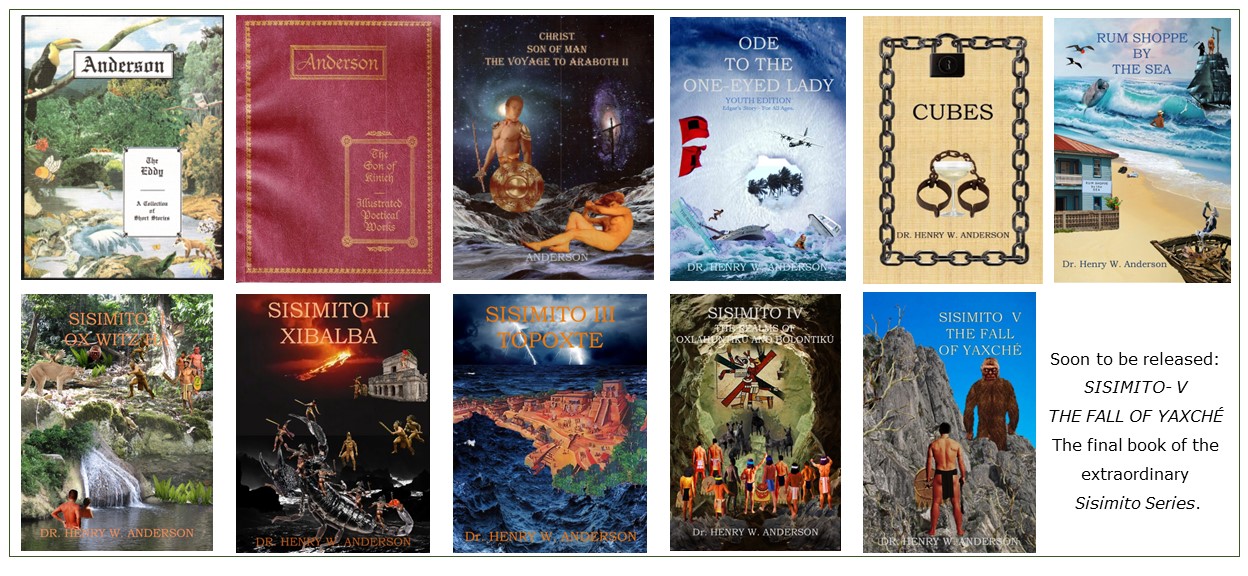 INFORMATION/LINKS The works by Dr. Henry W. Anderson are available at the libraries of the Belize National Library Service and Information System. For more information, please go to: https://www.bnlsis.org/ Once on the website, you may go to ‘Public Library Catalogue’ then to ‘Subject;’ select ‘Author’ and put in Henry Anderson; or use the link below to go directly to Dr. Anderson books: https://bnlsis.mlasolutions.com/m5/catalog/(S(tsaodaxofc2mvp3zhpl4wwt2))/Default.aspx?internal=1&installation=LeoBradley Dr. Henry W. Anderson books are also available as E-books and Print-on-Demand at store.bookbaby.com (BookBaby Bookshop), recommended, and other worldwide retailers: E-Book Retailers: Amazon, Barnes & Noble, Apple Books, Vearsa, Kobo, OverDrive, Copia, Gardners Books, Baker & Taylor, eSentral, Scribd, Ciando, hoopla, Playster, and many more. Print-on-Demand Retailers: Amazon, Barnes & Noble, Powell’s and thousands of other stores and wholesale bookstore catalogs like Ingram and Baker & Taylor, around the world. For store.bookbaby.com, go to: https://store.bookbaby.com/profile/jabirubooksbelizecom If you know someone who would like to receive our monthly Newsletter, please have them go to CONTACT at our website and send us an e-mail. Please note that our Newsletters are also published on our FaceBook page at: https://www.facebook.com/JabiruBooksBelize Visit our website at http://jabirubooksbelize.com. 
.
|